
This post contains affiliate links.
My dad was a big fan of Westerns, and particularly John Wayne. We watched and discussed lots of them as I was growing up. One of my favorites is McLintock, (1963) a western comedy that is lots of fun. But I didn’t know it was an adaptation of a Shakespeare play until just a few years ago, when I had an epiphany as I watched the movie again. “That’s an adaptation of The Taming of the Shrew!” I had just shown Shrew in my dramatic structure class, so the plot was fresh in my head.
It’s pretty hard to mess up a Shakespeare story even if you’re John Wayne. But it’s also a great way to introduce his stories to those who think his work is inaccessible.
I took two Shakespeare classes when I was studying theatre. The way I learned to understand his language was to read the play along with an audio recording of actors performing it. Once I began to understand the language, I fell in love with his work. And I began to notice stories based on his plays all over the place, like McLintock. Of course some of the details in such adaptations are changed from the original play, but still we get the benefit of the themes of the original stories.
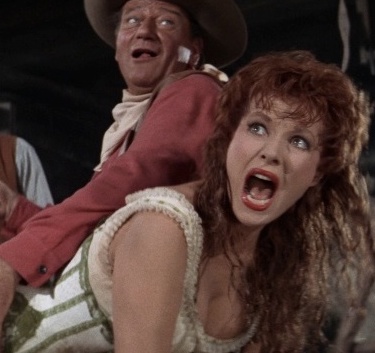
In the case of John Wayne and Maureen O’Hara, they’re a middle aged married couple with a grown daughter who is just coming home from finishing school. The feud, of two years standing in this case, is over lipstick on George Washington McLintock’s collar. G.W. doesn’t know why Kate’s angry which makes his and our finding out part of the fun. However, it still has that problematic scene where G.W. spanks his wife to get her to give up her grudge.
The way Petruchio treats Kate in the play is also problematic, but I’ve seen productions where, in the end, Kate manages to gain an equal footing with her new husband and gain his respect. To my mind, the play is a study in psychology because Kate is a shrew for a good reason. Her father loves Bianca, Kate’s sister, the most and doesn’t even try to hide the fact. Fortunately, Bianca’s deviousness gets exposed in the end.
In McLintock, the story centers around Katherine and G.W., while their daughter plays a much nicer Bianca, type character. Katherine’s reason for being angry is not so clear cut as in the play. Supposedly Wayne was trying to make a statement about marital abuse by either spouse. It’s a little hard to see that, but Kate IS verbally and even physically abusive to G.W. because of the lipstick thing. The only way G.W. can get Kate to stop and listen to him is to spank her in front of the whole town at the climax of the movie.
The movie has other messages as well. For example, G.W. is the big man in the territory, but he honors the Native people too and thinks they got a raw deal from the Government, i.e. their representation in most westerns he was in, but had no control over. He and his daughter, Rebecca, have a heart-to-heart about marriage, and how a man and woman grow together by facing the tough times. And that’s why when he dies she will not inherit the entirety of his huge ranch. He’s giving most of the land he’s acquired to the country for a nature preserve. So, even though the movie is a fun romp with funny fight scenes, and all kinds of colorful characters, Wayne does manage to slip in some meaningful things for the audience to think about.
John Wayne is, of course, not the only person to adapt Shakespeare’s plays for a more modern take, or even to fit a different culture than Elizabethan England. There’s a partial list on Wikipedia if you care to find ones you might want to watch. Bollywood has made several. Macbeth was adapted by the famous, Akira Kurosawa into Throne of Blood. There is a long list of more modern adaptations like, 10 Things I Hate About You, another adaptation of Shrew. She’s the Man, an adaptation of Twelfth Night, and of course the musicals like, Kiss Me Kate, Shrew again and The Boys from Syracuse, The Comedy of Errors. Side note, I was in a production of The Boys from Syracuse during graduate school.
Obviously there are too many adaptations for me to list here, but have some fun, watch an adaptation of a Shakespeare play and see if you don’t agree with me that his stories are just as relevant today as they were when he created them.
By the way, Shakespeare was an adapter as well. Most of his stories are amalgams of lots of different stories, so those who adapt his work are carrying on his tradition.
Thanks for reading. I hope you’ll go enjoy an adaptation of a Shakespeare play this week.
Blessings,
Lucinda Sage-Midgorden © 2023
Story-Power on Patreon
I’m so passionate about stories and what I can learn from them that I created the Story-Power podcast and Patreon communities so I’d have an excuse to talk story. You may have seen my Story-Power posts here. If you’re passionate about stories too, and want to talk about your favorite stories, come join me at patreon.com/StoryPower.
Saving the World One Story at a Time
Dale Carnegie wrote in his book How To Win Friends and Influence People, “Instead of condemning people, let’s try to understand them. Let’s try to figure out why they do what they do. That’s a lot more profitable and intriguing than criticism; and it breeds sympathy, tolerance and kindness. ‘To know all is to forgive all.’”
That’s why I’m hooked on stories. I get to watch the characters go through their emotional ups and downs, try to understand them and by extension, myself. If that sounds like something you’d like to try, you might want to consider taking my course Saving the World One Story at a Time.
Course Code: //www.udemy.com/course/saving-the-world-one-story-at-a-time/?couponCode=SAVINGTHEWORLDJULY23
PodMatch
If you are a podcaster, or have a message or fantastic product you want to share with the world, I encourage you to check out PodMatch. I call them a dating service for podcasters. Use the affiliate link and tell them, Lucinda sent you. Then contact me so we can set up a Story-Power chat.
 Sage Woman Chronicles