An amnesiac World War I veteran falls in love with a music-hall star after escaping from a mental hospital in the English Midlands, then suffers an accident which restores his original memories but erases his post-war life.
This romantic drama, released in 1942 was the favorite of their films of both Ronald Colman and Greer Garson. Gene Wilder revealed in an interview on Turner Classic Movies that this was his favorite film and that he also thought it was the best romantic film of all time. Sydney Pollack loved it so much that he wanted to do a remake, but decided against it since it was such a perfect film.
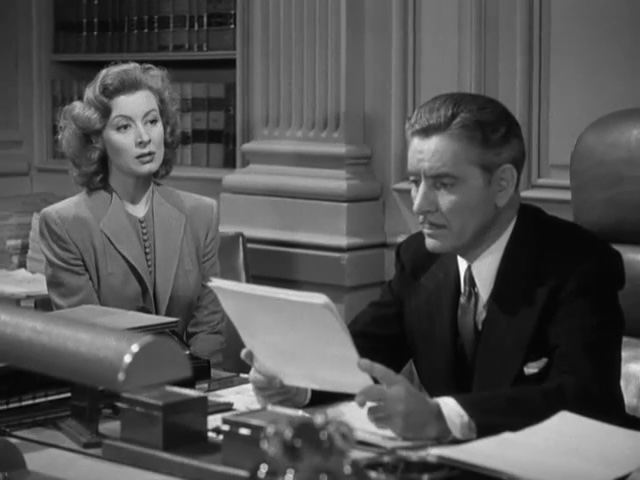
While the opening credits are rolling, the song that accompanies them is “O Perfect Love” often sung at weddings of the time period in which the movie takes place. The words express perfectly the theme of the movie. Part of the lyrics are, “… that theirs may be the love which knows no ending …” Paula/Margaret’s character, played by Greer Garson, has that kind of love for Smithy/Charles. In the photo above, Margaret has spent years searching for Smithy, as she knew him, to no avail until one day she sees his picture in the newspaper as “The Industrial King of England.” Hoping to jar him memory of their years together, she applies for and is hired as his private secretary. However, it takes a few years for him to finally put all the small little snippets of memory together to finally regain those years with her. Her enduring love and his struggle to regain those missing years is what makes the ending so satisfying.
If you haven’t seen this movie, it’s one that may restore you faith in humanity. There are no villains, no violence, only internal struggles similar to the ones we sometimes have. Who are we? Why are we here? How can we help others while continuing to improve our relationships and grow into even better people? 1942 was a very good year for great movies. This one is worth watching more than once.
Let me know what you think of the movie in the comments below.
Stories are a huge part of the way humans communicate with each other. Celeste and I think all stories are allegories where we can learn all kinds of important things, not the least of which is how to understand ourselves and others better. The best stories can be told over and over from one generation to the next and still teach great lessons. Emotional Intelligence and critical thinking are two of those lessons. Celeste and I think there are many classic movies that show us the progression of where humanity is today and we want to share them with you.
Shakespeare was right, “All the world is a stage and all the men and women merely players.” The stories we tell and consume are us trying to figure out who we are, why we’re here, and the kind of world we want to live in.
Come join the conversation on YouTube and our Facebook group.
 Sage Woman Chronicles