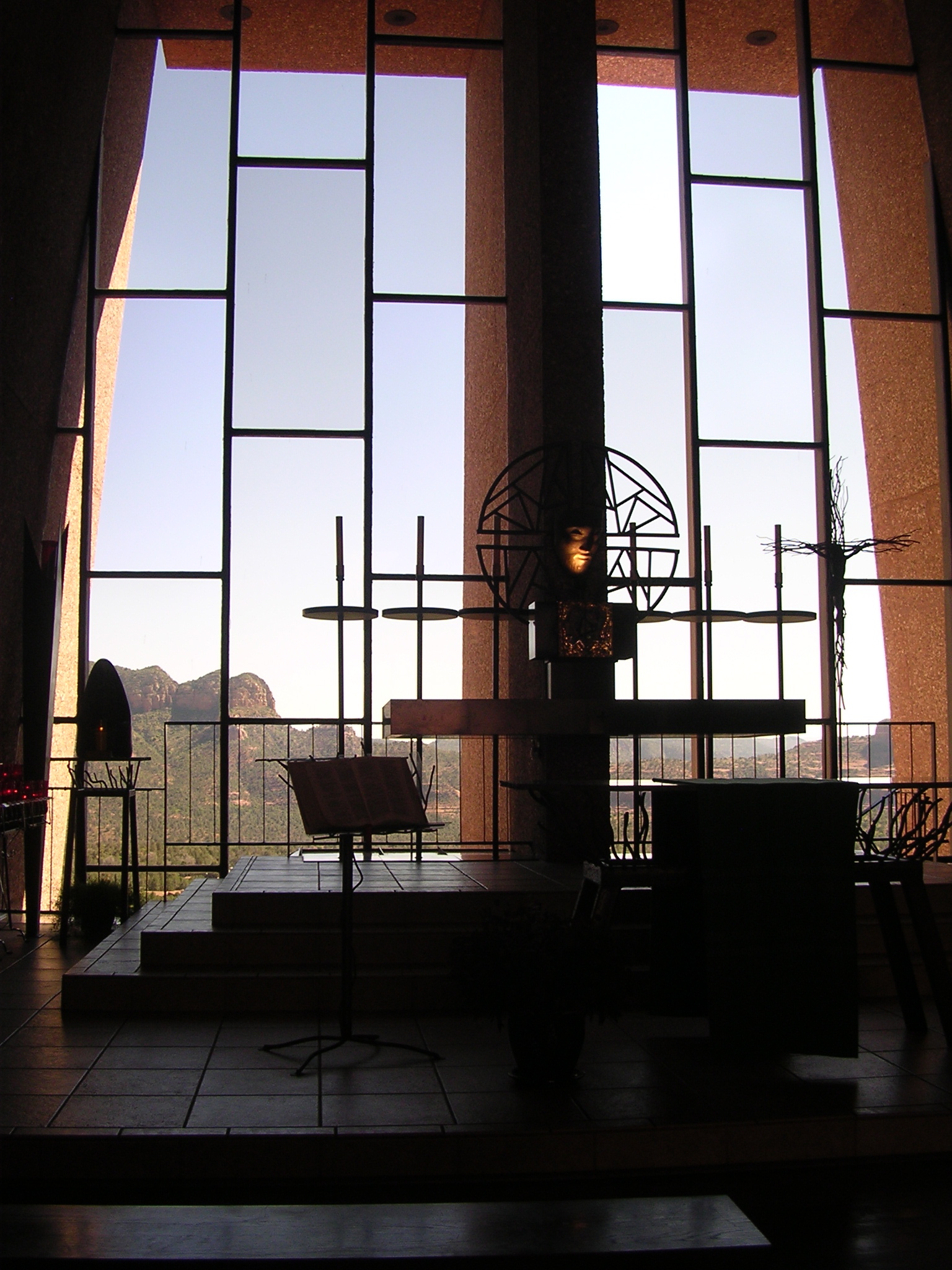
A Thirst for Silence

Chapel of the Holy Cross, Sedona, AZ

“We need to find God, and he cannot be found in noise and restlessness. God is the friend of silence. See how nature – trees, flowers, grass – grows in silence; see the stars, the moon and the sun, how they move in silence … We need silence to be able to touch souls.” – Mother Teresa

“Silence is a true friend who never betrays.” – Confucius

“The quieter you become the more you can hear.” – Ram Dass

Lately I’ve had a deep desire to be home, be silent, and work on my writing. Actually for most of my life, I’ve loved being alone, thinking my own thoughts and forging my own path. I’ve never been a joiner, and there have been times when I was misunderstood because I didn’t ascribe to the accepted point of view on a subject. For the most part that’s been okay with me because somewhere deep inside I felt connected to something much greater than myself. This isn’t a feeling I can articulate very well. It’s only been in the last few years when more and more spiritual teachers and scientists are espousing silence as a stress reliever and way to make sense of our lives, that I feel vindicated in my life long search for silence.

The other day a college friend of mine, Terry Green, who is an independent film maker and screen writer, wrote an interesting post on Facebook which described this feeling I’ve had for most of my life. He wrote that writers need to have a quiet, private place to write so we can hear what our characters have to say to each other. If we get out of their way, they will speak and all we have to do is write down their conversation. I love that. It’s so true. When I’m writing I have to get into a zone and allow what wants to come through speak to me. If I get out of the way, the voice that speaks is so much more articulate than I could ever be. I love this life of daily silence. What I’ve learned is that when I listen, I hear deep levels of wisdom that I would never have heard if I were still out in the noisy world.

It seems to me that anyone who is creative, and I believe that’s all of us, need silence to regroup and regenerate. If I don’t have silence during my waking hours, then I find it harder to sleep because my mind is too busy with the noise of the day to allow me to relax enough to go into deep sleep which is where we have the opportunity to be renewed. I also wonder if we would have any of the wonderful inventions, scientific theories, or artwork we enjoy today if it weren’t for the inventor, scientist, or artist taking time to be silent and listen to the inspiration that was trying to get through the noise of their everyday thoughts.

There is a great story about Albert Einstein I heard on a biography of him on one of the science channels. When he was stuck on the next step of a theory or mathematical problem he was working on, he’d ride the trolley car. He’d ride until his head had cleared and the answer to his dilemma presented itself. I loved that story because, in essence that’s what I do when I’ve got a dilemma.

The last five years of my public teaching career, I had to drive an hour each way to get to and from school. Though the drive was long, it was also a great time to have silence. There were so many times while I was driving in silence, that the answer to some problem at school with a student, or the play I was directing, or a lesson I was going to teach would come to me. When someone asked me why I didn’t listen to music, or audio books as I drove, I said, “Because driving in silence allows solutions to my problems to come to me.” Our minds need time to process so we can come up with an entirely new solution to whatever project we happen to be working upon.

I’ve found silence to be of great solace and source of my own creativity and I believe everyone, even extroverts need some of it every day.

Lucinda Sage-Midgorden © 2015

Facebook
Twitter
Goodreads
LinkedIn

Compassion Can Change Lives

SOO-wreath - Creative Commons.org“Freedom cannot be learned by tyranny of any kind, and the perfect equality of all God’s Sons cannot be recognized through the dominion of one mind over another.” – A Course in Miracles

“Love and compassion are necessities, not luxuries. Without them humanity cannot survive.” – Dalai Lama

“It’s one of the greatest gifts you can give yourself, to forgive. Forgive everybody.” – Maya Angelou

What if you made a huge mistake? I mean a really big one that society says is unforgivable? How would you feel? I don’t know about you but when I make even little mistakes, I beat myself up over it. If I made a huge mistake, I’d feel so much shame, I’d never want to show may face out in the world again. But if someone showed me compassion and forgave me, I’d be able to feel better about myself.

Last Sunday my husband and I saw a segment on CBS Sunday Morning, one of my favorite shows. My husband and I watch it faithfully every Sunday morning. Almost every Sunday I cry during at least one of the segments.

Last Sunday there was a story that made me think again about compassion and forgiveness, and how it can transform someone’s life. The title of the story we saw was “The Gainesville Tornadoes Thank Their Unexpected Fans” filed by Steve Hartman. Click Steve’s name to go to the CBS Sunday Morning page and watch the segment. I was touched by the story because it’s about the Gainesville Tornadoes who are young men serving time for felony offenses at the Gainesville, Texas Juvenile Correctional facility. The team is made up of students who have been on their very best behavior. When they get to play, they play teams from private schools like Vanguard College Prep in Waco, TX. The remarkable thing about this story is that the Gainesville Tornadoes rarely, if ever, have any fans. They are, after all, from a correctional institution, so none of their classmates can attend the games and most of the time their parents aren’t able, or don’t want to attend their games either. So not long ago, two Vanguard basketball players cooked up a scheme. They asked half their fan base to cheer for the Gainesville team, because as one student put it, “It’s no fun playing when the other team has no fans.” The thing is, by the end of the game, all the fans were rooting for the Gainesville players, and that was just fine with the Vanguard team. When Steve Hartman said, “This is not what I’ve ever seen sports be.” One of the students responded, “I think in a way this is kind of how sports should be and kind of showing you the real impact that encouragement and support for anybody can make.” Go watch the segment and if it doesn’t touch your heart, then you won’t understand the point I’m trying to make in this post.

We all need to be shown compassion when we make mistakes. It shows us that someone understands us. I know it’s hard sometimes to show compassion when we’ve been wounded by another. When that happens, we put on our armor and think that we’ll be safe inside it. But what retreating inside our armor does, is separates us from others.

Most of us are wounded people lashing out at other wounded people thinking we’re going to feel better by being the first to attack. This sets up a vicious cycle. The only way to stop the cycle is to do what Atticus Finch tells Scout to do in To Kill A Mockingbird, “You’ve got to put on another man’s shoes and walk around in them for awhile; see things from his point of view.” That’s how you cultivate compassion. If each of us stays inside our armor, we’ll never change the world for the better.

When I see a story like the ones Steve Hartman files on Sunday Morning, I rejoice. His stories always make me cry, because they are so hopeful. He tells about people in the world who are willing to set aside their personal goals of winning or being successful to help another person feel like there is someone who cares about them. Isn’t that what we all want? We want to feel needed and heard. We want to feel useful and we want to feel like we’re not the only ones who make mistakes. And on the other side, we want to feel like we’re making the world a better place in which to live. To do that we have to shed our armor and be the person who makes a difference in someone else’s life.

Thanks to my new and old followers. Please leave a comment below and connect with me on one or all of my social networks.

Lucinda Sage-Midgorden © 2015

Facebook
Twitter
Goodreads
LinkedIn

A Thing Worth Doing

Julia working at the wheel.

“It’s impossible to explain creativity. It’s like asking a bird, ‘How do you fly?’ You just do.” – Eric Jerome Dickey

“Try not to become a man of success, but rather try to become a man of value.” – Albert Einstein

“Do not go where the path may lead, go instead where there is no path and leave a trail.” – Ralph Waldo Emerson

“The journey of a thousand miles begins with one step.” – Lao Tzu

Faster isn’t always better. Fast food isn’t always the best for us and fast isn’t always better when working on any kind of project. Unfortunately, we live in a fast food society. We want instant gratification in many aspects of our lives from our food, to our entertainment, to our success. My father used to say that it was better to pay more and get exactly what you want than to save a few dollars and buy junk. And it’s better to spend time and effort on something worth doing than to rush the process.

Artist, scientists, and inventors all know about taking your time to make sure the painting, the experiment, the invention is done in the best way possible. Teachers know that their students can’t learn their lessons all in one day. Each school year’s lessons build on what the children learned the year before, the semester before, the day before. So why do some people want to rush the process of what matters most in life?

This morning the title of the one of the instructional writer’s blogs I read was this: “How fast can you write a book? (and why that’s the wrong question)” In the post, Jurgen Wolff, was cautioning his readers not to fall for any program or book that states that you can write a best selling book in only a few days, weeks or months. I know from experience that he’s right.

In the last month, I’ve been contemplating the amount of time it has taken me to get my novel, The Space Between Time, finished and ready for publication. I started it in 1999, set it aside for ten or so years and then picked it up again in 2010. Once I’d started the book, it was always in the back of my mind. I was thinking about the characters of Morgan and her father Thomas. Since I’d started the book as a tribute to my father, I didn’t want to give up the idea of finishing it. Now, of course, the main theme has changed slightly. There are two main characters, Jenna and Morgan. They connect through time to learn from one another. But it was my father who inspired me to write the book and that fact keeps me plodding along toward publishing the work he inspired. My father didn’t know that he was my inspiration and now he’s gone yet isn’t that how it is. Little and big things speak to us and help us grow, or inspire us to create something beautiful.

I’ve written before, that I finished the rough draft of this novel a year ago last December. Over these last fourteen months, I’ve allowed myself to take a step back to get a more objective view of the story lines and see where they can be improved. Writing a book is a long and sometimes tedious process. At one point I was feeling impatient. I wanted the book to be finished and I said something to that effect to my husband. I nearly wept when he said to me, “What you’re doing isn’t easy. It takes time to create something worthwhile.” I was so grateful to him for saying that because it’s true. Anything worth doing is worth doing right. So I’m an advocate for slowing down allowing yourself to take your time to build your success, to get that education, to heal your wounds and build a life worth living.

I’m happy to say that my manuscript is nearly finished now. I can feel it in my bones. That doesn’t mean there still won’t be some tweaks to be made to it. But I feel proud that I didn’t rush the process to publish it last year. It wasn’t ready then. I have to admit, I’m glad I’m a plodder when it comes to any creative project I do whether it’s writing a book, or directing a play. Taking the time to examine all the layers of what needs to be accomplished is a good thing. Whenever I’ve rushed through any project, I’ve been sorry. Rushing creates stress and stress isn’t good for optimal success on what you want to accomplish. So I encourage everyone to use slow and steady progress where creativity is involved.

Thank you to all my followers, new and old. Feel free to leave a comment and connect with me on any of my social networks.

Lucinda Sage-Midgorden © 2015

Facebook
Twitter
Goodreads
LinkedIn

On Reading and Writing

My Favorite Books
My Favorite Books

“You don’t start out writing good stuff. You start out writing crap and thinking it’s good stuff, and then gradually you get better at it. That’s why I say one of the most valuable traits is persistence.” – Octavia Butler

“Learn as much by writing as by reading.” – Lord Acton

“If you don’t have the time to read, you don’t have the time or the tools to write.” – Stephen King

I’m a member of Goodreads social network. At the beginning of the year I pledged to read 50 books. That’s a small amount of books compared to the number some of my friends and family members read every year. However, I enjoy savoring a book. I look forward to going to bed early, reading and then dreaming about the book. I find myself thinking about it at various times during the day and if the book is good the characters come alive for me.

About a year or so ago, I joined a book club group made up mostly of women who had taken my journaling class. It’s interesting to be part of the group because many of the books we read are not ones I would ordinarily choose. The latest book the group chose was, in my opinion, boring. It’s always distressing to me when I begin a novel that fails to grasp my attention because I know how much time goes into writing a novel. In a way, I feel like I’m betraying the author by not liking his or her book. Writing a novel is a huge investment of time and effort. I always want to be completely enthralled by every book I pick up, so when I begin one that I don’t like, I feel sad. I was going to slog through this particular book to the end because I felt a responsibility to the author and my fellow book club members. However, eventually, I just couldn’t continue reading.

Part of me felt bad about putting aside a book that was written by a New York Times best selling author. I thought, “Who am I to say the book wasn’t good.” Then I thought, “I’m a reader, that’s who I am. I have a right to say whether or not a particular book speaks to me.” The wonderful thing for readers is that there are so many books available. We will undoubtedly find many books that touch our lives throughout our reading lives and some books just won’t be worth our time.

As a writer, I feel sad about this particular book because I wanted to like it. It’s historical fiction during the time of the Civil War. Part of the novel I’m writing takes place during the Civil War, I was hoping to get a different perspective about the war from reading this book. I have to say that some of the scenes did give me a different perspective on the war, which is something I always look for in a good book.

As is my custom, I thought long and hard about what it was about the book that made me dislike it. I believe that’s an important exercise for all writers to undertake. The answers can help us become better writers. I’m lucky because I have a background in theatre. I’ve done lots of analyzation of plays and characters. In my opinion, what was missing from this particular book was an emotional connection among the characters. In my mind, all the greatest stories have something in common. They are multilayered and deal with universal themes. When the reader or audience can get a glimpse into a character’s soul, that’s what grasps our hearts and makes us continue reading. This particular book missed the mark in terms of character motivation and connections among the characters.

I’m in the final stages of getting my novel ready for publication. You can be sure, I’ll be going through my manuscript to make sure I’ve done the best I can to make the characters live on the page. At the same time, I’ll have to remind myself that not everyone is going to like my book. That will have to be okay. It will hurt when people write bad reviews, but as the Octavia Butler quote above says, this novel I’m working on might be crap, but I’ve got to keep writing so I can improve my skills. And I’ll keep reading to learn as much as I can from both good and bad books.

Lucinda Sage-Midgorden © 2015

Facebook
Twitter
Goodreads
LinkedIn

The Essence of a Person

Calla Lilies
Calla Lilies

“Don’t forget – no one else sees the world the way you do, so no one else can tell the stories that you have to tell.” – Charles de Lint

“In the long run, we shape our lives, and we shape ourselves. The process never ends until we die. And the choices we make are ultimately our own responsibility.” – Eleanor Roosevelt

“The strangest part about being famous is you don’t get to give first impressions anymore. Everyone already has an impression of you before you meet them.” – Kristen Stewart

“The most beautiful thing we can experience is the mysterious. It is the source of all true art and science.” – Albert Einstein

Last week as I was browsing Facebook, I found a link to an article in The Guardian in which it was lamented that Colleen McCullough’s obituary in an Australian newspaper was more about her looks and relationships with men, than about her brains and the many best selling books she created over her long career. As the reporter points out, it’s not the first time that articles about women concentrate more on a woman’s physical attributes and role she has played as a mother, or lack of it, before listing her other accomplishments.

That got me thinking. What is the essence of a person? Are we our looks, our family relationships, our job, or our accomplishments? Or is there something much more mysterious deep inside each of us? I think that many of us are afraid to explore who we really are which makes me sad. Think of all the wonderful things that could be accomplished if everyone was completely self-actualized.

Women are particularly plagued with image comparisons, but men face this problem too. There is a nebulous measuring stick out there for what constitutes an attractive, successful, smart man or woman. It’s a set of qualities that no one, or very few people can live up to. And if they could live up to them, would they want to? Who wants to be put into a category?

Wouldn’t it be nice if instead of looking at someone’s physical appearance, education, or situation in life, we could look into their soul and see the real person underneath? What would we find I wonder? Why is it most of us don’t care to look farther than skin deep? I know I’m asking a lot of questions, but this whole idea has been on my mind lately.

I wrote several weeks back about the fracas in my family at the end of last year. One effect of that event is that I struggled to see my sister and brother for who they really are at their essential level, rather that to judge their actions which at first caused so much pain. When I calmed down, two things came to my mind. First, they either didn’t have any idea of the effect of their actions or they thought they were doing the right thing. Second, when we have a conflict with someone, they are in essence holding up a mirror so we can examine our own motives and unhealed places. So how can I fault anyone who irritates, or attacks me? When that happens, I’m getting a chance to learn a great lesson about myself. Once I came to that conclusion, I realized that we’ll never really know another person unless we allow ourselves to look with different eyes so we can get a glimpse of their soul. To do that, we must delve deeply into our own soul. We must accept ourselves as we are with no recriminations.

The fact that Colleen McCullough’s fans raised an outcry about her obituary is just one sign that maybe people are waking up to the fact that each person is a unique gift to the world and should be honored. After all, her fans saw into her soul through the many books she wrote. When you become a fan that way, you accept the beauty of the artist’s soul and it doesn’t really matter what they look like. Maybe her fans find it easier to honor the people they meet in their everyday lives as well. Wouldn’t it be nice if that were true?

Today as I sat down to write this blog installment, a Facebook friend posted a list of qualities that are not measured by academic tests. The list was developed my Maria Montessori, a pioneer in the field of education. As I read the list, I felt that many of the things on it are also qualities that are overlooked when we reduce someone to the superficial things we first notice about them. Here are just a few things on the list: creativity, critical thinking, resilience, motivation, persistence, curiosity, humor, self-awareness, self-discipline, empathy, compassion, sense of wonder, and humility. We each have so many qualities inside of us. We are so much more than a small list of qualities that are supposed to be important. It’s my hope we will all discover who we really are so that we can appreciate others at a deeper level thus honoring who they really are.

Lucinda Sage-Midgorden © 2015

Facebook
Twitter
Goodreads
LinkedIn