“It’s not what enters men’s mouths that’s evil. It’s what comes out of their mouths that is.” –Paulo Coelho The Alchemist
“If you do not tell the truth about yourself, you cannot tell it about other people.” –Virginia Woolf
Cochise Flowers
Recent events, and subsequent comments about them in the media have got my ire up. A white man, Donald Sterling, shows his true colors, and the brouhaha is on. In an” Open Letter to White People: Why I’m Donald Sterling and So Are You,” The gist was that all white people are racist, and we’d better admit it. What made me so irritated wasn’t what the author wrote, but the tone of the article. If you want to influence people, you get more with honey than you do with vinegar.
I’m not saying that this article is completely wrong. What I’m saying is that if you want us to take a good hard look at ourselves,accusing all whites of being racist is the wrong approach. In fact, EVERY SINGLE PERSON on this planet, except for those who are enlightened, like Jesus, Buddha and others have been, carry some kind of prejudice around with them. And we ALL need to check ourselves for prejudices of all kinds.
I know I’m not perfect, but I am continually working on becoming more open and loving. I’m always double checking my attitudes. I’m working on myself, so that I can be an influence for good in the world, and help humanity evolve to a deeper level of being. And I don’t believe in the “when one person messes up, everyone in the class gets punished,” mentality. So, I get angry when someone tells me I’m prejudiced just because I’m white.
We can’t know what is in the deepest heart of another person. To lump an entire group together, and accuse them of having exactly the same feelings, is unrealistic. Not all Germans are bad, because Hitler was the leader of Germany during WWII. Not all people from Arab nations are bad because those who were behind the 911 tragedy were from Arab countries. Not all Mexicans are in this country illegally. Not all Black people are gang members, and commit crimes. Not all Asians are smart, and make cheap products that fall apart the first time you use them. Not all white people feel entitled because they’re white. I could go on and on, but you get the point.
We have a lot of problems in this world. As I see it, the only way to solve them is for every single person to take a close look at themselves, as the article suggests. If we take care of the mess in our own backyard, and every single person does that, it makes solving the world wide problems so much easier.
In my opinion, we need to thank the Donald Sterlings in our world. They point out areas in our society where we still have work to do. He’s not the only one who has made comments that we need to be scrutinizing. There are lots of intolerant people mouthing off in the media. We need to be examining what they’re saying as well, and checking our attitudes about their points of view. They are showing us areas in our society where we need to work on becoming more tolerant of the plight of others.
I know this much about myself, when I’m judgmental of other people’s actions, I’m doing that because they’re showing me an area of my life that I don’t want to look at. I’m trying to blame them for the mess in my own backyard. If I resist hiding my head in the sand, and look at my faults, my heart opens up. I understand myself, and the faults of others.
Don’t get me wrong, everyone needs to accept responsibility for what they do. But, if we’ve done our own work, it’s easier to have compassion for someone when they mess up. We are after all, imperfect human beings.
I read another article last week that helped me feel better about what’s going on in the world. The title is “7 Things Self-Actualized People Do Differently” It’s an article that gives us all something to shoot for in our self-improvement journey. If we can achieve the seven states of being described in this article, we’ll be contributing to the growth of the human race.
“Many of life’s failures are people who did not realize how close they were to success when they gave up.” –Thomas Edison
“It does not matter how slowly you go as long as you do not stop.” –Confucius
“There is only one thing that makes a dream impossible to achieve: the fear of failure.” –Paulo Coelho, The Alchemist
Fireworks at the Ocean
A year ago today, I heard a small voice tell me to begin Sage Woman Chronicles. After a year, I’m even more committed to continuing these weekly posts than I was a year ago. I’ve learned so much about myself. Isn’t that what a grand adventure is supposed to do? Some would say that sitting at home writing a blog, and a novel, as in my case, isn’t a grand adventure. But, in the novel, The Alchemist, which I just finished reading, the Shepherd learns to listen to his heart, and look for omens that send him off to the next step in his journey. For some people that looks really big. For others, like me it’s smaller. The point is that each of us has a purpose, and if we don’t fulfill that purpose, a piece of the big cosmic puzzle is missing.
I don’t mean to discourage any of you, but it took me about thirty years to hear my heart, and allow myself to become who I was meant to be. I’m a late bloomer. Now that I’ve overcome the inner critic, the fear of stepping into the unknown, and started my writing career, I’m so much happier. I feel free.
It hasn’t been easy. I had to do a lot of self-examination, and healing. Finally, I was ready to embrace the real me. And miraculously, one day I saw two roads stretched out in front of me, calling to me to make a decision. For years I’d buried my desire to be a writer. When I looked down the writer road, I was filled with elation. The other road made me feel like I had a stone in my belly.
I often wonder if other people get feelings in the pit of their stomach when they make big decisions. Are we so desensitized that we’re out of touch with our own feelings. I can understand if that’s how things are for you. It takes courage to face up to our emotions, the good and the bad. So many tragedies have happened over the last decades that most of us are shell shocked. But, here’s the thing, stuffing your feelings, and pretending they won’t resurface is a fallacy. The only way to move forward, and be happy is to face what happened good and bad. As my sister says, “You’ve got to throw out your trash”. I can speak from experience. If you throw out your trash, you’ll feel much lighter, life will become more joyous, and you’ll find the courage to follow your dreams.
Last week, I completed the second round of revisions on my novel. It’s about a woman named Jenna, who’s life crashes, causing her to face herself, and build a new life. She gets lots of help along the way. I’m including a scene in today’s post, which happens near the end of the book. I’m not sure if I’ll keep it in the manuscript. However, it sums up part of what happens because Jenna chooses to follow the omens that lead to the fulfillment of her dreams.
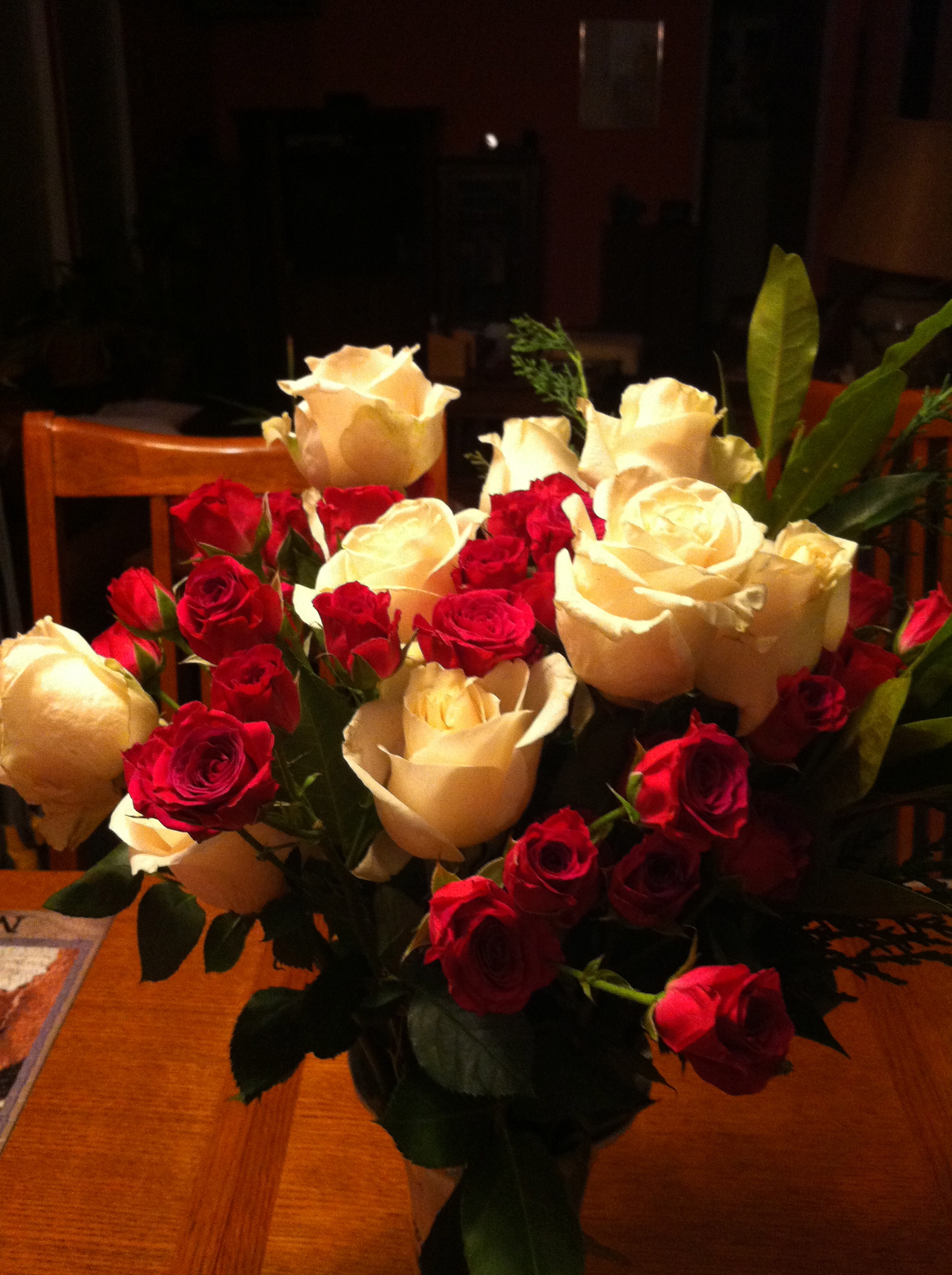
Roses from the Cast
Jenna was glad that she had an entourage of spirit help the first time she came face to face with Fletcher and Mr. Drayton in court. Anger and hatred emanated in huge waves of black swirls toward her as she took the stand to testify. At first she was terrified. Never had she felt so much animosity from anyone. But, as she was being sworn in, she was encircled in a protective dome of light. Each time the black swirls shot out from the two men, they dissipated when they touched her protective dome. For months, and years, she’d felt slimy, and defiled after each encounter with these men. Now she knew why.
At one point during her testimony, she was asked to look over at the men to identify them. When she did so, she saw that they were surrounded by spirits trying to get through their barrier of hatred, to no avail. All of a sudden the dread of seeing them in person again faded, and the dream she’d had of them being sucked into the darkness, returned as vivid as it’d been that night all those months ago. She’d lived in their shut-off world before Black Friday. Thank heavens she’d found Morgan’s journals that had guided her toward the light. All she felt for Fletcher and Mr. Drayton was sorrow. How sad that they didn’t know all the love that awaited them.
When she’d given her testimony, she went back to her seat next to Jack. The trial was nearly over. From what she’d heard, the outcome was pretty clear. They’d know very soon now, as the closing arguments were set for the next day.
That night, at Ben and Joan’s apartment, Jenna told the others about her experience, and about her dream.
“Man, you have the most interesting experiences. My life seems so boring by comparison,” said Joan.
“Well, I wouldn’t recommend having your life crash down around you as a personal growth tool,” said Jenna. “But, I guess it all depends on how stubborn you are. I was pretty stubborn.”
“Fletcher and Drayton are even more stubborn than you were Sweetie,” said Jack. “It was nasty just being in the same room with them. I pity the jury. They must be getting an extra dose of hatred sent their way.”
“Maybe I don’t want to go tomorrow after all,” said Joan. “But, I told Mr. Winston, I wanted to be there to hear the verdict. He agreed.”
“I’ll be glad to have you there,” Jenna said.
“I wish I could go, but I’ve got a big meeting with a client,” said Ben. “I want to hear all the details.”
The next day the courtroom was packed. Jenna, Jack, and Joan got there early to be sure to get seats. The back of the room was full of reporters from all over the country. This was big news.
The prosecutors final remarks were short, and to the point. However, the defense attorney’s remarks dragged on. He tried to refute all the evidence that had been presented. According to The Oregonian articles Jenna had read about the trial, his efforts were futile. Finally, the jury was given their charge by the Judge, and court was adjourned while they deliberated. Joan took Jack and Jenna to a new coffee shop near the courthouse. Half an hour later, they were called back. The jury was ready to pronounce their verdict.
“I think that’s one of the shortest deliberations I’ve ever seen,” said Jack. “And I’ve testified in some open, and shut cases. This wasn’t an easy, or a short trial. They must have made up their minds at some point during the testimony.”
The three friends slipped into their seats just as the Judge was entering the courtroom. He banged his gavel for silence. The jury filed in.
“Mr. Foreman, have you reached a verdict?” asked the Judge.
“We have your Honor.” The Foreman handed a slip of paper to the Bailiff, who took it to the Judge. The Judge read it, then handed it back to the Bailiff, who took it back to the Foreman.
“Will the defendants please rise,” said the Judge.
The Draytons stood with impassive faces.
“Please read the verdict, Mr. Foreman.”
“We the jury find the defendants guilty on all counts,” said the Foreman.
The courtroom erupted into cheers, and chatter. Photographers took photos of the shocked faces of the two men. Jenna noticed that the the black swirls, which had emanated from them toward the jury, were quickly sucked in close to their bodies.
The Judge banged his gavel. “Silence.” When everyone was again seated, and quiet the Judge said, “Thank you jury for your verdict. I set the date for sentencing for a week from today. Court is dismissed.”
Jenna was surprised to find herself surrounded by photographers as she, Joan, and Jack left the courtroom.
“Oh oh,” said Joan. “I didn’t see this coming. I’ll run, and get the car so we can make a quick get away.” She pushed her way through the crowd, and disappeared.
Reporters were pointing microphones in Jenna’s face. The barrage of questions was so intense that she couldn’t make coherent sense out of anything anyone was saying. Jack with his arm around her, was shielding her as they made slow progress out of the courtroom, down the corridor, and down the courthouse steps. As they descended, they veered to the left to avoid the podium set up at the bottom with the Prosecutor standing in front of it about to hold a press conference. He whispered to one of his colleagues, who rushed over toward them.
“Mr. Ross would like you to be a part of the press conference. He says it was your testimony that brought such a quick verdict.”
“Tell him thank you, but no. I’m glad it’s over. He can take all the credit.”
“Okay, but he’ll be disappointed.”
As the young man ran back to the podium, Jack said, “Let’s get out of here quick, before he comes back.” He steered Jenna toward the corner closest to the parking garage exit. In a matter of moments, Joan was heading up the ramp. Jack opened the back door. Jenna, and he jumped in. Joan turned right into traffic.
“Wow, thanks for your quick thinking,” said Jenna. “I had no idea we’d be mobbed.”
“Me either,” said Jack. “Though I should have. Without you, the Draytons might never have been caught.”
“Where do you want to go?” asked Joan.
“Home to Roseburg.” said Jenna
California Coast
Like Jenna, I hope you find the courage to follow your dreams. The world needs what you have to offer.
“For masterpieces are not single and solitary births: they are the outcome of many years of thinking in common, of thinking by the body of the people…so that the experience of the mass is behind the single voice.” –Virginia Woolf
“Laziness may appear attractive, but work gives satisfaction.” –Anne Frank
“The only way to enjoy anything in life is to earn it first.” –Ginger Rogers
“To fulfill a dream, to be allowed to sweat over lonely labor, to be given a chance to create, is the meat and potatoes of life. The money is the gravy.” –Bette Davis
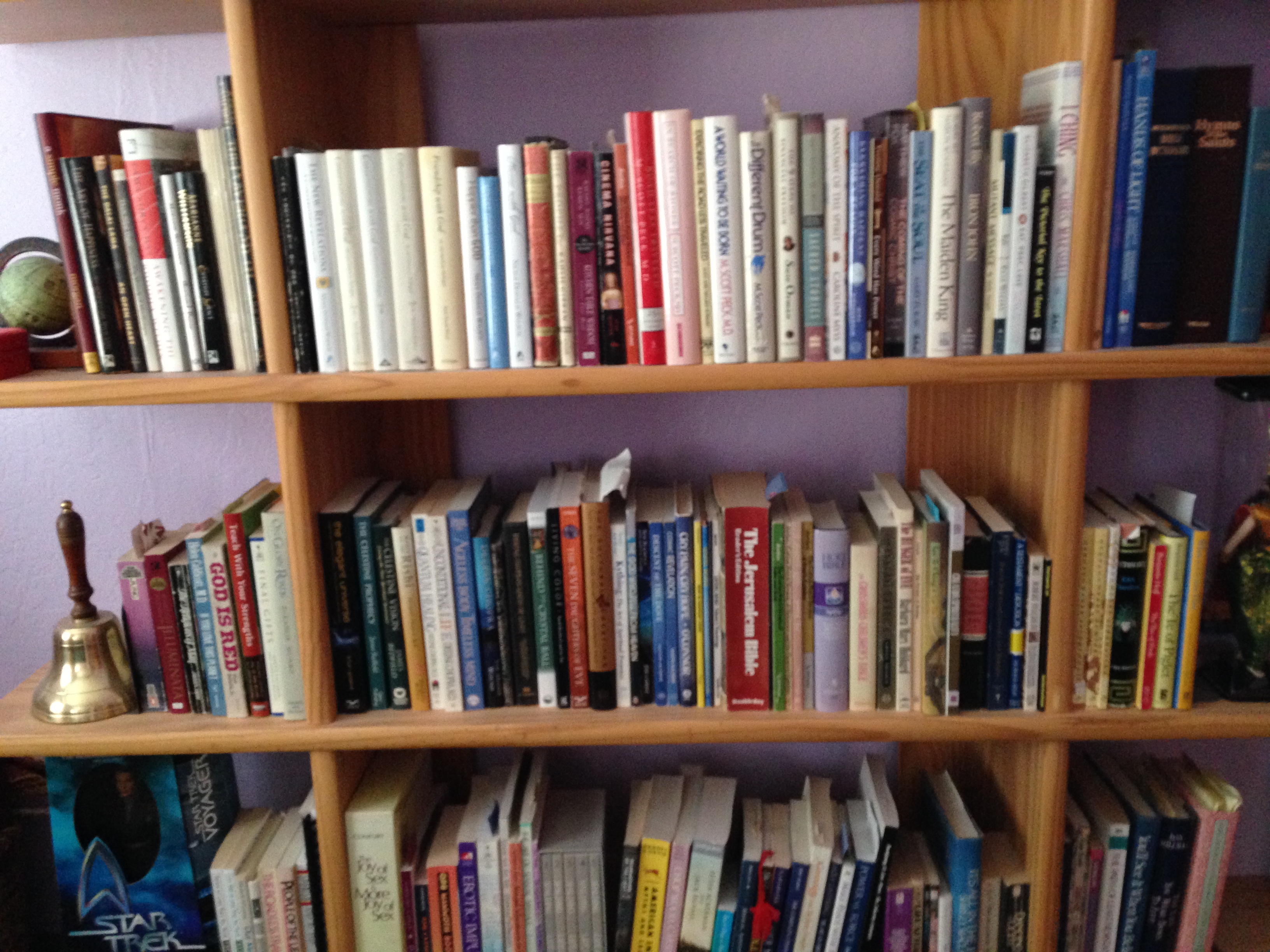
Bedroom Book Shelf
Humans are interesting. Do you do this? You’ve been working on a big project. It’s a success, but instead of feeling joy, you feel a big let down? I do it all the time. Whenever a play I’ve been directing ends its run, I feel both happy, and sad. I’m happy that the play was a success, but sad because the associations are over. I won’t be working with the actors, and crew again, perhaps forever. And as my college mentor used to say, I’ll miss the characters. Maybe it also has to do with the fact that success is an ephemeral thing. The good feelings don’t last forever, and there is so much more to me, than the things I’ve accomplished.
This week, my emotions have been bouncing around, which is unusual for me. I’ve felt elated, frustrated, sad and lost, all because my novel is nearing completion. Four or five people are reading it to help me improve the storyline. I’m anxious to get their comments back. One minute, I’m sure they won’t like it, and I’ll have to do major revisions before it can be published. The next, I’m sure the basic story is good, and I’ll only need to make minor revisions. I’m excited to be close to completing the work after four plus years. However, I also feel uncertain. What will my next novel be about?
I hadn’t thought of doing a series of books when I began this novel, but I understand why they’re so popular. I’ve become attached to my characters. I’m not sure I want to let them go just yet. Then, I do this funny thing after seeing a movie, play, or reading a book I love, I think about what would happen to the characters after I’ve seen the last frame, or read the last page. What will their lives be like? What other adventures will they enjoy?
I’ve been thinking those thoughts about the characters in my book. I did set up the possibility of a second, and possibly third novel with this same set of characters, but I wasn’t seriously thinking about writing sequels until this past week.
What prompted me to consider writing a series of books, is due to two things. First, two of the very minor characters in the book are Suffragettes. The other had to do with reading “A Room of One’s Own”, by Virginia Woolf, my book club group selection for this month. It’s considered a feminist document simply because she’s reflecting on what a woman needs to express her genius in the same way men have been able to do for centuries. (Side note: She’s not anti-men in her reflections, which I thoroughly appreciated. The men in my life, are fantastic, and highly supportive.)
So, I’ve been thinking about going back to those Suffragette characters, and exploring how they made a difference for women like me; women who want to develop their creative skills, and be more than just a housewife and mother.
What’s interesting about this budding idea is that, for most of my life, my close friends were men. I went to two different high schools, and had one woman friend at each one. The rest of my friends were young men, and I don’t mean the men I dated. It was the same in college. Of course, that was because my first degree was in Religious Studies, as I’ve written before, and I was the only woman in most of the classes. It’s only been in the last few years, that I’ve had close women friends. So, I’ve got this growing idea to do some exploring about the roles of women in society, and how we’ve changed it.
As of today, I haven’t made up my mind about what my next writing project will be. All I know, is that I’m going to begin another novel project right away. I won’t be able to improve my skills by sitting around waiting for book sales. One thing I’ve learned since I began this writing adventure is that I must do the work. That’s what gives me joy, and makes me want to get out of bed in the morning. What makes you want to get out of bed every morning?
“We’re not what books and plays say we are. We’re not what advertisements say we are. We’re not in the movies and we’re not on the radio. We’re not what you’re all told and what you think we are: We’re ourselves. And if any man can find one of us he’ll learn why the whole universe was set in motion. And if any man harm any of us, his soul–the only should he’s got–had better be at the bottom of that ocean–and that’s the only way to put it.” Mrs. Antrobus from The Skin Of Our Teeth, by Thornton Wilder
Does this happen to you? I start to read a book, and the stars align or something, and the ideas in the book that grasp me the most start to pop up everywhere. At present I’m reading a long essay, which is based on a series of lectures delivered by Virginia Woolf. The compiled essay is titled “A Room of One’s Own”. It’s our book club selection for this month. The thing that appalled me, but shouldn’t have, were some of the things Ms. Woolf discovered about women’s rights while preparing to deliver the lectures on “Women and Fiction”.
In 1928 women had little access to education. They were considered property by their fathers, and husbands. Only a few years before the lectures, women had won the right to vote in England, and to keep the wages they earned. What appalled me was how little things have changed in eighty-six years. I began comparing what’s happening now, with all the fracas about equal pay for women, women’s health issues, the way women are portrayed in the media, and I felt really sad. We haven’t gained much ground. This was confirmed when I talked with my sister a few days ago.
She was telling me about the Palm Sunday service at her church. They had a guest speaker, who happened to be a woman. In her talk, the guest speaker told of the difficulties she faces from time to time, because she’s a woman, and she’s a minister. I thought surely things would have changed, since I was harassed for declaring myself a religious studies major in 1976, but not so. She often gets the same kind of reaction that I got thirty-eight years ago, which makes me sad. Things haven’t changed much for women.
Thirty-eight years ago, I was attending a small Christian college, and the only woman in the small group of religious studies students. Women were just beginning to be ordained as ministers at the time. When word got around that I’d changed my major to religion, I was the target of harassment by a conservative group at the college. Each day, at meal times, a group of three or four young men would quote scripture at me, and challenged me to see the error of my ways, and change my major to something more appropriate for a woman. Needless to say, it was a very difficult time for me. They assumed that my plan was to become a minister in our church, which wasn’t even a possibility at that time.
My reason for studying religion, was because I’ve always been interested in the relationship between humans, and the Divine. Over time I became deeply angry at these young men. No matter what I said, or did, they were undeterred from challenging my life choice. In my mind, it was MY choice, not theirs. I didn’t think they had any right to tell me how to live my life. They needed to take care of their own life choices. Eventually they gave up, assuring me that I was going to hell for breaking God’s laws. I became an angry feminist.
In 1979, I graduated with my degree in Religious Studies. It has set me on a path of lifelong learning about all things spiritual, for which I’m eternally grateful, because through my studies I’ve realized that men are just as stuck in their gender roles as are we women. It’s difficult to break out of social patterns, and long held beliefs.
Looking back, I realize I was able to stand up for myself, because I had supportive parents. Both parents. My mom worked outside the home, and I had a great dad who encouraged me to find my own path, and live up to my full potential. We need more dads like that. I think my dad was so supportive, because he’d been misunderstood by his teachers. He was told he was lazy, stupid, he was a trouble maker, and he’d never amount to anything, all because he had dyslexia. I’m not sure doctors were even aware what dyslexia was in the 1940s. Thankfully, my dad was strong and wise. He dropped out of school, learned to be a machinist, taught himself how to read, and became a lay minister in our church. Reading was one of his favorite things to do. He didn’t read light stuff either. He loved to read biographies, and non-fiction scholarly books, like Carl Jung.
My dad could be a good dad, because he had a good dad, and because he studied human nature. He was vulnerable, kind, and open to new ideas. He wasn’t like some of the male writers that Virginia Woolf found who stated in their books that women were inferior to men, mentally, physically, and morally. My dad didn’t think he was superior to anybody else. He thought that EVERYONE has a purpose, and should look for, and pursue that purpose.
You may not have had a dad like mine, but I say to all women, don’t give up. We’re rising. We’ve got to continue exploring who we are, and what we can offer humanity. Don’t blame men for what’s gone before. That’s not helpful. Men have been trapped by their gender roles, and ways of thinking too. What we need to do is educate them about who we are. We possess much depth of understanding about what it means to be human. We are peacemakers, healers, thinkers, creators, and teachers. We’re good at all the same things men are good at. The best thing is, we have genius even we haven’t tapped into yet.
“I find hope in the darkest of days, and focus in the brightest. I do not judge the universe.” -Dalai Lama
“What we have done for ourselves alone dies with us; what we have done for others and the world remains and is immortal.” -Albert Pike
Arizona Butterfly
I’ve been weeping most of the morning, because I found out yesterday that one of my college students died over the weekend. She was 23 years old. I had her in three of my classes, so I got to be blessed by, and enjoy her sense of humor, her intelligence, and her smiling face. Her death is tragic. I’m tempted to ask why this happened, but I know that it’s just the mystery of life.
Something about her death brought back the sense of loss I felt when my seven week old nephew, and some years later my father died. What does it all mean? I don’t know, but I have a deep feeling inside that everything that happens to us has a purpose. Even the bad stuff has meaning.
Now, I’ve heard scientists, and researchers say that we’re hard wired to find patterns, make connections, and find the deeper meaning of things. Some people think life is just absurd, and there is no purpose to anything. Maybe they’re right. Today, I’m leaning in that direction. But here’s the thing, if there wasn’t a purpose why are we here?
You can tell me that life on this planet developed through a series of coincidences. That an uncaring god created us, or everything exists because of random cosmic events. Go ahead and believe that if you want to. I just don’t buy it. Maybe I don’t buy it, because I’ve always known that there is a higher power of some sort. I’ve experienced her/his presence, and had profound life altering experiences, which lead me to conclude that everything in the Universe has a purpose. Every being contributes vital energy, or maybe something deeper, to whatever mystery is going on; the mystery of life.
Brené Brown says we’re hardwired for connection. Weddings, graduations, birthdays, health challenges, promotions, job losses, births, and deaths help bind us closer together, if we let them. If that’s the only purpose we have for sharing this planet, then I’m in. I want to deepen my connections with my loved ones. I want to bring something to the table that helps others grow and expand. My student did that.
A year ago, almost to the day, she played Glinda the Good Witch in a juvenile production of The Wizard of Oz. It was a joint production with the elementary school and the college. The students loved her. Throughout the rehearsal process, she helped them understand that giving in to petty personal feelings hurts you, your performance, and hurts the show. She helped them understand what it means to be a disciplined performer. I know that’s not her only legacy, but that’s a huge one. Something she could be proud of.
So, today I’ll weep for my loss, and the deeper loss her family, and friends feel. I’ll trust that the ripples she set in motion during her short life, will continue to grow, and add meaning to those of us who remain.





 Sage Woman Chronicles