Life’s Tapestry

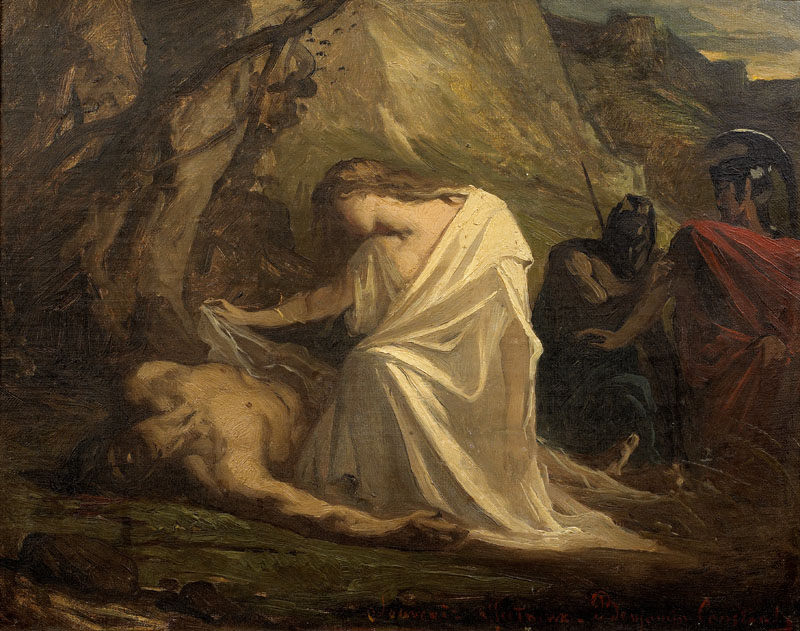
Antigone burying Polynices, her brother.

“When we meet real tragedy in life, we can react in two ways – either by losing hope and falling into self-destructive habits, or by using the challenge to find our inner strength. Thanks to the teachings of Buddha, I have been able to take this second way.” ~ Dalai Lama

“The mark of your ignorance is the depth of your belief in injustice and tragedy. What the caterpillar calls the end of the world, the Master calls the butterfly.” ~ Richard Bach

I’ve written more than once recently about how current events are affecting me. I’ve been extremely tired. Some days I feel despair that we’re going to destroy ourselves and the planet. And yet, something in my DNA turns me toward optimism. I believe each of us is part of a huge ultimate plan for a better collective life. None of us can see the big picture but I cling to the hope that we as a species are going to survive and more than that thrive, eventually.

This past semester my acting friend and I mentored an honors student for the honors colloquy. My friend suggested a fantastic historical monologue for her. She planned to give a short presentation about the historical context of the play, and then perform the monologue. As we rehearsed, we all felt like the monologue had so much to say about current events and I think we were all deeply affected by the ideas expressed in it.

The monologue came from the play Antigone by Jean Anouilh, based on the ancient Greek play of the same name by Sophocles. It’s a famous Greek tragedy and in true tragedy, each character’s fate is predetermined before they are even born. There is no escape no matter how hard they try. In most tragedies there is an imbalance in the society and the main character, usually the king, must be brought down. They usually die in their effort to set things right. Needless to say, all versions of Antigone are very heavy plays.

I’m not sure I believe in fate the way the ancient Greeks did. Yet I do believe we choose the outline of the life we are going to live before we are born, which is a kind of fate. There are lines in the monologue that resonate with me because in my mind they support my point of view and yet offer new things to consider. Here’s a section that I continue to think about. “In tragedy, nothing is in doubt and everyone’s destiny is known. … HE WHO KILLS IS AS INNOCENT AS HE WHO GETS KILLED: IT’S ALL A MATTER OF WHAT PART YOU ARE PLAYING. Tragedy is restful; and the reason is that hope, that foul deceitful thing, has no part in it. There isn’t any hope. You’re trapped. … and all you can do is shout. … you can get all those things said that you never thought you’d be able to say – or never even knew you had it in your to say.”

Sometimes I wish I were more blunt and just said what’s actually in my mind. There are things I’d love to say, but I don’t want to create more division than there already is. There is so much imbalance in societies all over the world. I struggle with what part I’m playing in what’s going on. I want to help effect positive change, but I’m often confused. Ultimately, I feel like none of the roles people play are right or wrong, they are all part of the bigger tapestry that humans have been weaving since we were created. Yet, it’s one thing to be looking back at times like these. Living in the chaos is difficult. What I take from the monologue is that we all have opportunities to shout. To say things that we never thought we’d be able to say, or even knew we had it in us to say. I struggle with just blurting out the way I see the world, or to do as I have been doing, quietly suggest new ideas for consideration.

The end of the line I quoted above helps me a bit. “And you don’t say these things for their own sake; you say them because you learn a lot from them.” I believe when I express my true opinion respectfully, others learn something from it. And maybe that’s the thing I love so much about this monologue. If we not only speak our minds, but listen to each other, especially those who don’t agree with us, we have a possibility to learn vital new things that might change the pattern of the tapestry and make it more beautiful.

I don’t agree with Sophocles and Anouilh about hope. To me there is always hope that we can create new more beautiful sections of the tapestry if we’re open to new ideas. There are people I love who do not have the exact same opinions I do about politics, or religion, or even basic things like how to do household chores. I could get angry and demand that they change to come into alignment with me. Or I could remember that everyone is as innocent as I think I am. It feels like time to stop drawing lines in the sand and feeding conflict and divisiveness. I don’t always feel courageous enough to let go of my prejudices and reach out to people who don’t have the same background I do. However, no matter what is going on in my life, I keep coming back to the fact that love and cooperation feels so much better than conflict. I believe it’s collaboration, caring and compassion that will get all of us through all the challenges we face personally and collectively.

Here is an interesting historical note: Anouilh’s play was written during the Nazi occupation of France. At first performances were banned because of its controversial nature. But in 1944 the Nazi’s changed their mind. When it was performed an interesting thing happened, the Nazi’s thought it was a validation of their quest to rule the world. While the French citizens saw a deeper meaning. Neither group knew their ultimate fate, but the play gave the people who saw it hope that maybe the Nazi’s fate was to fail in their quest to rule the world. In the play, Creon, Antigone’s uncle and the new king asserts his power without mercy. He wins his political cause but he loses the moral one. Even though Antigone dies for her convictions, she’s the moral winner. The play was Anouilh’s statement that there is no way for us to know the ultimate fate of humanity, or sometimes even the role we play in each lifetime. All we can do is to live our lives the best we can and occasionally shout against our fate. If we do, we might help ourselves and someone else understand something that was never thought of before, something vital to the big tapestry we’re all creating together.

Thanks for reading my musings. I appreciate your likes and comments. I hope you nurture hope and shout against injustices whenever you feel compelled to do so.

Lucinda Sage-Midgorden © 2019

Lucinda is the author of The Space Between Time, an award finalist in the “Fiction: Fantasy” category of the 2017 Best Book Awards. It’s a little bit like Outlander in that it’s a historical, time-travel, magical realism, novel. Only Jenna’s life is shattered. When she finds old journals, she joins consciousness with her three-times great-grandmother, Morgan, instead of traveling physically. She is able to come back at intervals and apply what she’s learned to her own life situations.

The Space Between Time is available in all ebook formats at Smashwords, or you can find the ebook at iBooks or Barnes and Noble. If you prefer a physical copy, you can find a print-on-demand version at Amazon. Stay tuned for news on the audiobook version Lucinda is working on. To join her email list, click here. She will never sell the names on her list.

Emotions, Strong or Weak?

Lucinda’s Birthday with Arielle

“A work of art is a world in itself reflecting senses and emotions of the artist’s world.” ~ Hans Hofmann

Negative emotions like loneliness, envy, and guilt have an important role to play in a happy life; they’re big, flashing signs that something needs to change.” ~ Gretchen Rubin

I’ve been thinking about emotions or the lack thereof a great deal lately because of all the things going on in the world. There are so many people who seem to be completely disconnected from empathy and compassion that it’s distressing to me. On the other hand people are emerging who are just the opposite. It’s as if we’re having actual battles between good and evil, just as is reflected in our popular entertainment.

Where did that notion come from that showing our emotions is weakness I wonder? If a person being interviewed on TV cries, or if someone shows emotion in real life, they say “I’m sorry” as if showing their true feelings is bad. That makes me sad. I know showing vulnerability is difficult. But think of the alternative. Would you rather have relationships with people who are in touch with their emotions, or with people who are emotionally absent?

This spring Barry and I have been watching the third season of Masterpiece Mystery’s Unforgotten. It’s about a team of detectives in London who investigate crimes from the past. A body that has been long buried is found and the team must try to find the murderer. This season was quite chilling. When the team discovered who the murderer was, it turned out he was a psychopathic psychiatrist. He bragged about being a serial killer of young teenage girls. The actor playing the psychopath gave a chilling performance countered by the emotional performance by the actress playing DCI Stuart. Which character was stronger? The one with no emotions at all, or the one so connected to the dead girls and their families that she could barely stand to be in the same room with the killer? I go with DCI Stuart. Her compassion for the families helped them heal years of uncertainty and pain.

As a writer I struggle with writing emotions. It’s so much easier to reproduce them as an actor because replicating body language and facial expressions help me connect with the character and audience. But when I write character emotions, I must think of how my body feels when I’m experiencing various emotions. Where does fear reside in my body, or grief, anger, or joy? And then how do I write those physiological responses so the reader feels those emotions with my characters?

Of course, what happens in the real world influences my writing. I’m nearly finished with the rough draft of Morgan’s timeline in, Time’s Echo. And all of my thoughts about emotions made me notice the holes in my character’s emotional lives. I’m going to have to do a better job of describing their emotional states. A year or so ago, I might have been tempted to rush through this book, but it feels too important to get the emotional component right. Not that I did a terrible job on the first book, but the stakes are much higher for my two main characters in this one. I want to take greater care with writing what they’re going through and how they feel about it.

Being able to write what I’ve been contemplating has done one thing for me. I’m not as ashamed to show my true emotions as I used to be. I used to be an observer. A fly on the wall rarely interacting with people I didn’t know. But over the years of acting, teaching and writing, I’ve learned to make deeper connections with those around me. That’s a good thing I think. I’d rather risk making emotional connections than be completely alone. That’s extremely sad and stressful and it doesn’t help anyone, especially me.

So, now that my teaching semester is over, I’ve got more time to do a better job of writing the emotional lives of my characters. Oh, and finally get back to recording the audio version of my first book.

Thanks for reading, liking and commenting. Welcome new to my new followers. I hope you have a fabulous weekend.

Lucinda Sage-Midgorden © 2019

Lucinda is the author of The Space Between Time, an award finalist in the “Fiction: Fantasy” category of the 2017 Best Book Awards. It’s a little bit like Outlander in that it’s a historical, time-travel, magical realism, novel. Only Jenna’s life is shattered. When she finds old journals, she joins consciousness with her three-times great-grandmother, Morgan, instead of traveling physically. She is able to come back at intervals and apply what she’s learned to her own life situations.

The Space Between Time is available in all ebook formats at Smashwords, or you can find the ebook at iBooks or Barnes and Noble. If you prefer a physical copy, you can find a print-on-demand version at Amazon. Stay tuned for news on the audiobook version Lucinda is working on. To join her email list, click here. She will never sell the names on her list.

Reading Lessons

“The more that you read, the more things you will know. The more that you learn, the more places you’ll go.” ~ Dr. Seuss, I Can Read With My Eyes Shut!

“Books are the quietest and most constant of friends; they are the most accessible and wisest of counselors, and the most patient of teachers. ~ Charles W. Eliot

Reading grasped me when I was a senior in high school. We studied British Literature that year. I was enamored with A Tale of Two Cities, Jane Eyre, and Shakespeare. Everything we read opened up my perspective on history, and how the different characters lived. I knew I didn’t want to be like Miss Haversham in Great Expectations. On the other hand I very much liked Jane Eyre’s self-confidence, and A Tale of Two Cities immersed me in the horrors of The French Revolution.

It wasn’t that I hadn’t been a reader before, but we didn’t have access to libraries, except for the school libraries, in the small towns in which I grew up. The Scholastic Book Fair was always a treat and I did buy books that I enjoyed reading. But those were held only once or twice a year, and so it was often months between reading the books I wanted to read, and the ones I had to read for school.

But senior year I became a real reader. What I mean by that is that a real reader is always on the lookout for the next book they are going to read. And now that I’m semi-retired, and have more time for reading, I feel uneasy if I have to wait even a day to find the next book to sink into. That rarely happens, though, because most of the time, I have a list of two or three possibilities waiting in line.

The advent of social media groups like Goodreads has helped me up my reading game with their yearly reading challenge. For the last few years I’ve pledged to read 50 books a year. I know for some people that’s not a lot, but I like to read a book slowly, savoring and living within the lives of the characters.

I’ve tried to understand why I feel this need to sink into other people’s lives. I do it with movies and TV too. Maybe I’m a voyeur, but I think it’s because I’m just one person and I can’t possibly experience every aspect of life. Yet I have this need to understand the world from different perspectives. And when I talk or listen to other readers, they say similar things about why they read.

I secretly wanted to be a writer for many years. When I finally acknowledged that fact, I wasn’t sure I was going to be able to write effectively. After all my degrees are not in English. But when I read a quote I believe was by Stephen King, “You can’t be a good writer if you don’t read,” that made me feel better. I am learning how to be a good writer by reading both good and bad books. A poorly written book can sometimes teach me more than great ones because they show me in glaring detail the mistakes I make, or ones I need to avoid.

On the other hand there are great books that I still think about many years after I first read them. And maybe that’s the highest praise I can give an author, to continue to contemplate their work and how it affected me. And then try to write as powerfully as they did, only using my personal experiences and point of view.

I’m grateful to be a reader. It’s hard for me to imagine what my life would be like if I didn’t read. I think it would be lots smaller and maybe even sadder. Reading about characters who experience terrible things, then grow, and even flourish as a result, gives me great hope.

Welcome to my new followers. Thanks for reading, liking and commenting. Have a fabulous weekend.

Lucinda Sage-Midgorden © 2019

Lucinda is the author of The Space Between Time, an award finalist in the “Fiction: Fantasy” category of the 2017 Best Book Awards. It’s a little bit like Outlander in that it’s a historical, time-travel, magical realism, novel. Only Jenna’s life is shattered. When she finds old journals, she joins consciousness with her three-times great-grandmother, Morgan, instead of traveling physically. She is able to come back at intervals and apply what she’s learned to her own life situations.

The Space Between Time is available in all ebook formats at Smashwords, or you can find the ebook at iBooks or Barnes and Noble. If you prefer a physical copy, you can find a print-on-demand version at Amazon. Stay tuned for news on the audiobook version Lucinda is working on. To join her email list, click here. She will never sell the names on her list.
Star Wars Day – Life Choices

Tarantula Nebula

“Only I can change my life. No one can do it for me.” ~ Carol Burnett

“Familiar things happen, and mankind does not bother about them. It requires a very unusual mind to undertake the analysis of the obvious.” ~ Alfred North Whitehead

I love the Star Wars series. I love it because to me it’s one example of our modern mythology. The way I see mythology, the stories are created to help us understand who we are, where we came from, and why we’re here. And the Star Wars series is just one group of modern tales that attempt to do that.

If nothing else, what the popularity of the Star Wars franchise teaches us is that if we’re not open to change, we can get caught up in destructive thought patterns. Literature and movies are filled with characters who latch onto something they desperately want but can’t have, or that they fear will happen to them. Darth Vader is so afraid of losing first his mother, then Padme, that his fear left him vulnerable to the dark side. And we all know where that leads him. He’s miserable and because of that he leaves a trail of destruction in his wake, especially for those he professes to love. He’s a very sad figure. His teachers try to help him let go of his fear, but for some reason, he is unable to do so.

In a book I’m currently reading, Sidroc: The Dane, a side book in Circle of Ceridwin series by Octavia Randolph, Ingirith, Sidroc’s step mother, is so angry that she was not free to choose her own husband that it sucks not only her happiness, but that of the entire family. Hrald, her husband is a good, kind, honorable man. But she’s too filled with resentment. She can’t let go of the dreams she built up in her head. The result is that she is unable to open her heart. She can’t see that she chooses not to allow herself to be happy.

I’ve been thinking of lots of other stories with characters who blame their lot in life, or what they think is wrong in the world/universe, on outside circumstances because I’m preparing the dramatic structure class that I will be teaching next fall. Each movie I watch has characters who hold fast to their view of the world and then cause pain for themselves and others. I love teaching this class because I’m enough of a nerd to enjoy diving deep into the stories and characters to see if I can learn anything new about my own life.

Last weekend, Barry and I went to see Avengers: Endgame. (Don’t worry, no spoilers here.) Thanos, the villain, is convinced that there are not enough resources to go around for all the gazillions of people in the universe, so he devises a plan to eliminate half of all living things to right this imbalance. He sees the problem as outside himself. He’s not willing to entertain the idea that perhaps there are other solutions to the problems faced by the populations on each planet. Nope, he’s convinced he’s got the solution and nothing is going to stop him from fulfilling his plan. As a result, he wreaks havoc. He’s the only one who appears to be happier as a result of his actions. But as a spiritual teacher I follow says, “Darkness always serves the light.” And in the case of Thanos, and other fictional arch villains, that is the case. Maybe it’s the case in real life too.

I’ve got a character in Time’s Echo that is caught in a loop of destructive thinking. At first I created Morgan’s daughter, Georgiana, to show the stresses women face trying to balance care of home and family with work and involvement in worthy causes. Thanos, and Ingirith made me think about Georgiana in a new way. She was born with a chip on her shoulder and nothing Morgan and Seth do helps. In fact, their efforts to help her, cause her to dig in her heels even deeper.

I have to admit, I don’t understand people like that, however, we all know those kinds of people. Nothing is ever their fault and the world is out to get them. On the other hand, we all know people who bring joy to everything they do. When they enter a room, it feels lighter and even when these happy people are faced with extreme challenges, they manage to find the bright side of the situation.

It’s my opinion that we choose what Caroline Myss calls our “sacred contract”, before we’re born. Even though I don’t fully understand it, I think we do choose who we’re going to be in any given incarnation. And to me that indicates that there must be a reason we do this.

There is a theological system called Process Theology, developed from Alfred North Whitehead’s Process Philosophy that might explain what I’m trying to say. The main idea is that in part God grows and learns from what we experience. Which makes me think that we may be part of a huge experiment to see if we can grow as a species, or if we’ll crash and burn.

I’m fascinated by the mystery of life, the fact that we each have unique personalities, perspectives, and roles to play in each lifetime. I have to admit that if we were all the same, life would be extremely boring.

Thanks for reading my current musings. Writing fiction makes me examine almost everything that happens to me personally, and in the greater world. And then it all becomes compost for what I’m working on.

Welcome to my new followers. Thanks for reading, liking and commenting. I hope you have a fabulous weekend.

Lucinda Sage-Midgorden © 2019

Lucinda is the author of The Space Between Time, an award finalist in the “Fiction: Fantasy” category of the 2017 Best Book Awards. It’s a little bit like Outlander in that it’s a historical, time-travel, magical realism, novel. Only Jenna’s life is shattered. When she finds old journals, she joins consciousness with her three-times great-grandmother, Morgan, instead of traveling physically. She is able to come back at intervals and apply what she’s learned to her own life situations.

The Space Between Time is available in all ebook formats at Smashwords, or you can find the ebook at iBooks or Barnes and Noble. If you prefer a physical copy, you can find a print-on-demand version at Amazon. Stay tuned for news on the audiobook version Lucinda is working on. To join her email list, click here. She will never sell the names on her list.

Pick a Little, Talk a Little

Caring Hands

“Fire and swords are slow engines of destruction, compared to the tongue of Gossip.” ~ Richard Steele

“Live in such a way that you would not be ashamed to sell your parrot to the town gossip.” ~ Will Rogers

A couple of nights ago The Music Man was on TCM. We tuned into it just as one of my favorite songs “Pick a Little, Talk a Little” started. Professor Harold Hill is trying to get some information about Marion the librarian. He’s a con man, and she’s a target who can help him achieve his goal. The song is so great because Meredith Wilson makes the women dishing dirt on Marion sound like a flock of chickens; “Pick a little, talk a little, pick a little, talk a little, cheep, cheep cheep, talk a lot pick a little more.” The thing about the women is that they think they know all about who Marion is and what she’d done, but, of course, they’re wrong. And their gossip is potentially destructive. But it’s a musical comedy, so everything turns out right in the end.

That song was just another example of things I’d been thinking about, how negative attacks, particularly in all kinds of media, erode society. It prompted me to write this post.

I’ve never liked gossip. I can’t say that I’ve never done it. I’ve said my fair share of negative things to and about people. After all, I’m human. However, acknowledging that fact does not make me proud, nor does it make me feel good when I’ve done it. In fact, it feels corrosive to my soul when I say nasty things about people. If it makes me feel bad, I wonder what is going through the heads of people who troll public figures and spew nasty comments about them as if it’s their life’s work. Do they think it will make them feel superior, or good about themselves? If my father was right, that is exactly what they think. But they’re wrong. If I attack another person, it damages me as much as it does them, maybe more.

Since the advent of social media, gossip seems to have become more prevalent. We’re no longer gossiping across the backyard fence. Nope, we can now throw nasty comments at people we don’t even know while we think we’re remaining anonymous. Some people wear their corrosive opinions like a badge. All the hate language online shows me that self-hatred is an epidemic that we need to address. It’s as damaging as any virulent disease that attacks the body.

I often ask myself what can I do about this epidemic? The only true cure that I know of is for each person to clean out their own dark corners. I know from personal experience that it’s scary to look into those dark places. I’ve been attempting to love myself for fifty plus years and though I’ve come a long way, there are still times when that ugly self-hate demon rears its ugly head. When my self-hatred is triggered I’ve learned to take a deep breath and ask myself, “What am I supposed to be learning from this?” Then I get out my journal and write. Writing helps me figure out what is truly going on inside my head and heart.

This may sound naïve, but to stem the tide of hatred in the media, I ignore the articles or string of nasty comments that come through my feed. Oh, man sometimes I’m almost drawn in by those tantalizing headlines. I know, I’m just one potential consumer, however, if enough people get fed up with all the negativity, we will make an impact.

Part of the reason I decided to stop reading stories aimed at ripping someone apart is that I want to preserve the ground I’ve gained to become a happier person. Reading negative stuff makes me feel out of sorts. In fact, the other day after consuming lots of news, I yelled at Barry for some innocent remark he made. I knew immediately that I wasn’t angry with Barry. Nope, it was misplaced aggression. I’d fallen into the trap of consuming negative news.

Gregg Braden, an author and scientist I follow, marries science with spirituality. In a recent interview he said that scientific studies have shown that when we observe something happening, our brain thinks it’s happening to us in real time. So, if we’re watching movies containing brutal violence, it’s as if we’re either the perpetrator or victim of the violence. If we’re watching a sporting event, it’s as if we’re running on the court, or the field with the other athletes. Conversely, if we observe someone doing kind and loving things for others, it’s as if we are the beneficiaries of those kind deeds. Our brains and hearts are sponges. They take in everything that goes on around us. Knowing that makes me much more careful about the media I consume.

Sometimes when I’m writing this blog I feel like I get really preachy. I don’t want to do that but I do want to share what I’m thinking, because maybe I’m not the only one who’s questioning the situation I’m focused on that week. And as I learned from my father, asking questions is the beginning of learning something really important.

Truthfully, I don’t have any blanket answers about how to stop the hatred that seems so prevalent right now, except to keep working on being as loving as I can be. Maybe I’ll help someone absorb the kindness I’m dishing out.

Thanks for reading, liking and commenting. I hope it’s spring where you are and you can enjoy the flowers and warm weather. If you’re in the Southern Hemisphere, I hope you get to see a splash of fall colors to dazzle your senses.

Lucinda Sage-Midgorden © 2019

Lucinda is the author of The Space Between Time, an award finalist in the “Fiction: Fantasy” category of the 2017 Best Book Awards. It’s a little bit like Outlander in that it’s a historical, time-travel, magical realism, novel. Only Jenna joins consciousness with her three-times great-grandmother, Morgan, instead of traveling physically. She is able to come back at intervals and apply what she’s learned to her own life situations.

The Space Between Time is available in all ebook formats at Smashwords, or you can find the ebook at iBooks or Barnes and Noble. If you prefer a physical copy, you can find a print-on-demand version at Amazon. Stay tuned for news on the audiobook version Lucinda is working on. To join her email list, click here. She will never sell the names on her list.