“As you grow older, you learn a few things. One of them is to actually take the time you’ve allotted for vacation.” ~ John Battle
“The purpose of a vacation is to have the time to rest. But many of us, even when we go on vacation, don’t know how to rest. We may even come back more tired than before we left.” ~ Thich Nhat Hanh
“We will be more successful in all our endeavors if we can let go of the habit of running all the time, and take little pauses to relax and re-center ourselves. And we’ll also have a lot more joy in living.” ~ Thich Nhat Hanh
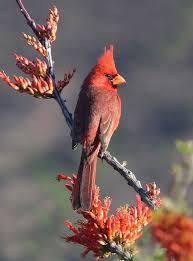
Cardinal
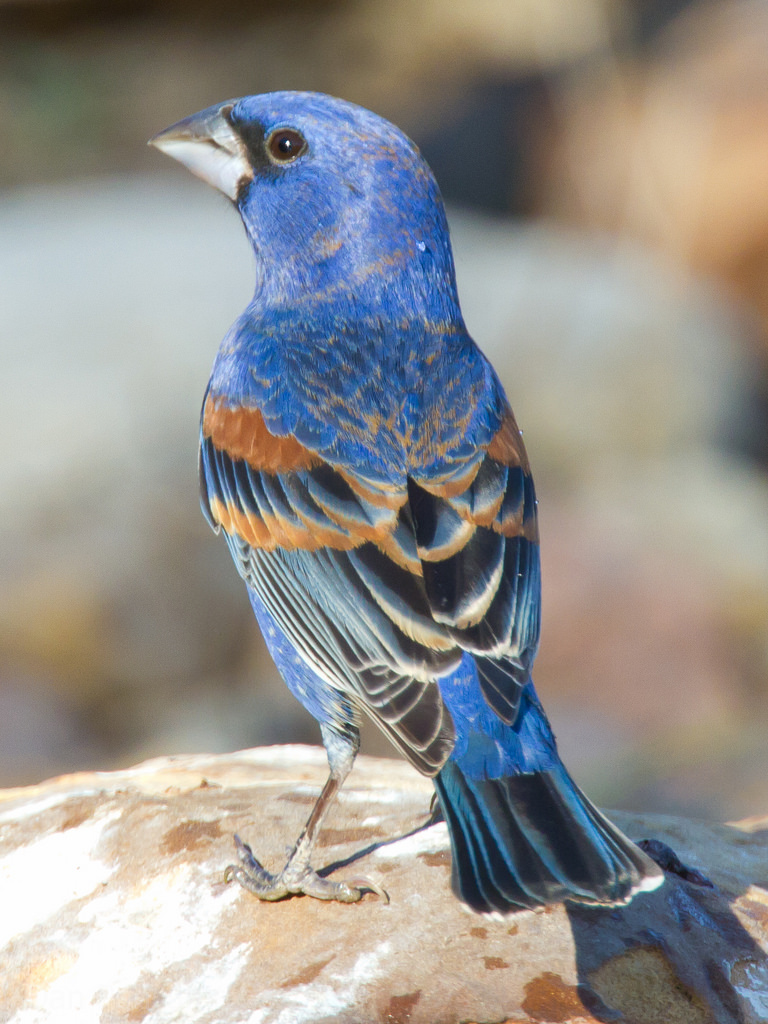
I started this blog five years ago this spring, and I think it’s time to take a little break. Coming up with things to write once a week, then twice a week wasn’t hard until just a few days ago. I know it’s been two weeks since my semester ended, but I’m still tired. I want to sit and watch the birds in our back yard and at the bird feeder, not to mention all the other wildlife that wanders past our windows. I want to read books and watch movies. I want to take walks with my husband. I want to sit and have quiet conversations.
My husband and I are taking a little vacation over Memorial Day weekend and I think I’ll give this blog a little rest too. It’s not that I’ve run out of ideas, it’s that I need to take time to just be for awhile.
In the meantime, here is the link for the video of Measure for Measure by William Shakespeare that I directed this spring. The students did a fantastic job of making Shakespeare come to life, even though we didn’t have nearly enough rehearsal time. I hope you will take a look. The themes are surprisingly contemporary.
I’ll see you in a week or two with new movie/book posts as well as things I learned while letting my mind take a vacation.
Thanks for reading, liking and commenting. There are plenty of past posts archived if you want something to read. But, I hope you take time to recharge your internal batteries as well.
Lucinda is the author of The Space Between Time, an award finalist in the “Fiction: Fantasy” category of the 2017 Best Book Awards. It’s a historical, time-travel, magical realism, women’s novel, and is available in all ebook formats at Smashwords, or you can find the ebook at iBooks or Barnes and Noble. If you prefer a physical copy, you can find a print-on-demand version at Amazon. To join her email list, click here. She will never sell the names on her list.
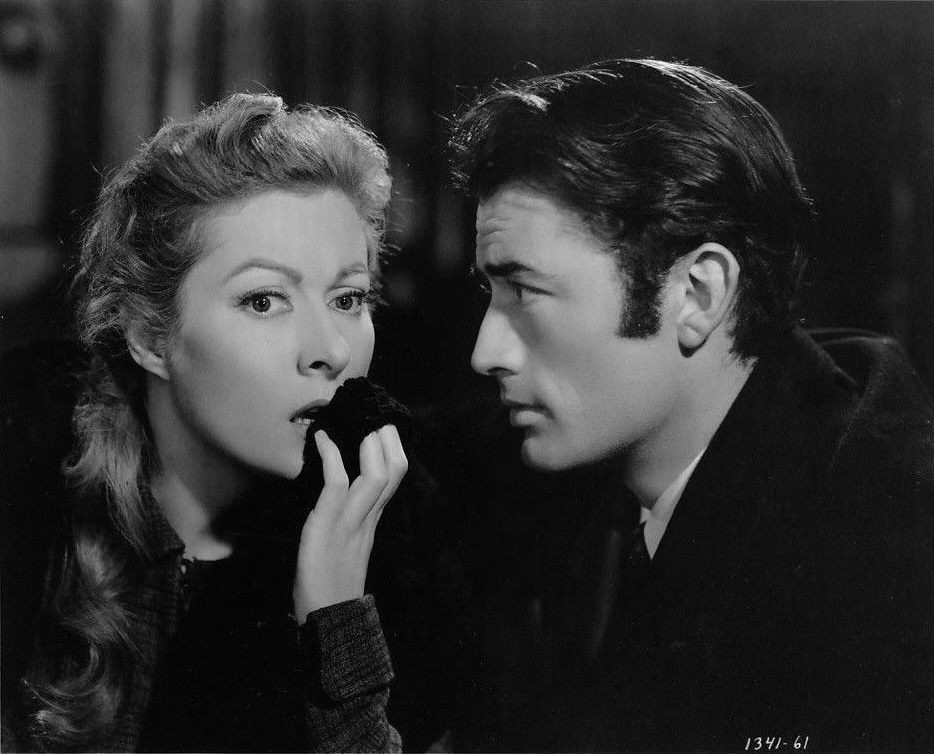
Greer Garson, Gregory Peck in The Valley of Decision
“Sometimes the questions are complicated and the answers are simple.” ~ Dr. Seuss
“The only way out of the labyrinth of suffering is to forgive.” ~ John Green, Looking for Alaska
“Lighten up, just enjoy life, smile more, laugh more, and don’t get so worked up about things.” ~ Kenneth Branagh
I don’t know about you, but sometimes I can get so set on certain ways of thinking that I block the good things that could be coming my way. The movie The Valley of Decision (1945), book by Marcia Davenport, is a story about people who get caught up in that kind of thinking and every time I see the movie, I want the main character, Mary, to make different decisions so she and Paul can live happily ever after. But if she did that, I might not be reminded to recheck my own thinking.
I know, I’m bit of a harpy writing all the time about stories that teach me something, or stories from which I learn important lessons. I do enjoy stories that are just fun for fun sake, like Mama Mia!. I’ll try to write about those kinds of stories more often, but today, The Valley of Decision is on my mind because I was confronted with some of my own intractable thinking recently.
If you haven’t seen the movie, I highly recommend it for a number of reasons. First, Gregory Peck and Greer Garson play the lead characters. It’s sad they didn’t do more movies together, because they have fantastic chemistry. Second, the story is a little bit of a history lesson about the steel industry in the late 1800s Pittsburg. In a way it’s a story about ingenuity and the love of creating the best product possible to help America grow. That’s the kind of story many Americans like. That kind of story comes in lots of different packages, from the people who invented computers, or cars, or a new movement in art, and we never get tired of them. This story happens to be about steel and for that reason, it’s a little bit nostalgic. Third, all of the secondary and supporting actors are fantastic which helps the audience become emotionally involved in their on screen lives.
At the beginning, Mary Rafferty has just graduated from Catholic School. She and her family live “on the flats” in Pittsburg where most of the steel workers live. Her father, Patrick, once worked in the Scott mills, but was seriously injured and is now in a wheelchair. Mary needs a job, because her widowed sister has just come home with her baby.
One interesting thing about this story is, though this is before the formation of unions, William Scott pays Patrick a monthly salary because he was injured on the job. We get the feeling this is an unusual situation and that William Scott is an honorable man. In spite of this, Patrick has turned his mind to hating the Scott family, so when Mary announces that she has just secured a job as housemaid in the their household, he’s furious with the nuns for sending her there, and with her for taking the job. She defies him, however, because they need the money.
It turns out that Mary falls in love with the entire Scott family and they with her, but most especially Paul. He is the only one of the three boys and one daughter who is interested in working in the mill. The others just want the money they get as shareholders.
Paul arrives home, the day Mary is hired to work in the house. He’s been to Europe studying different types of steel made there and is particularly interested in the open hearth method used in Germany. Over the next year or so, he and Jim Brennan, a friend of the Rafferty family, experiment with this new method. As Mary watches Paul work late hours and eventually become discouraged, the two fall in love. But when Paul asks her to marry him, two things stand in the way of her saying yes. She knows her father would not approve, and she’s a servant of the household. In her mind, she’s not of the same class, even though Paul and his mother, Clarissa, tell her that doesn’t matter in the least. They live in America after all.
In the end, after many years, Mary saves Paul and the mill when his mother bequeaths her shares to her. He finally finds the courage to get rid of his shrewish wife and he and Mary are able to be together.
The book continues on from that ending of the movie. Mary and Paul never marry, because she’s convinced the curse her father put on their union is real. But she becomes his housekeeper taking charge of his household affairs and raising his children when his wife dies. Every night they discuss plans for the mill, and his sons. Their relationship lasts until Paul’s death. Mary continues to live in the house which Paul left her until her death many years later.
Even though Mary and Paul find a measure of happiness in the end, their lives could have been so much richer if she had been able to see that it was her beliefs that kept them from having the full relationship they might have had.
Every time I watch the movie, and as I read the book, I compare Mary to myself. How have I blocked the happiness I might have had because I don’t think I deserved it. Watching it makes me want to stop being like Mary Rafferty and embrace all the wonderful things waiting for me to experience.
Thanks for reading, liking and commenting. I appreciate it. Have a fun weekend and maybe take time to watch The Valley of Decision.
Lucinda is the author of The Space Between Time, an award finalist in the “Fiction: Fantasy” category of the 2017 Best Book Awards. It’s a historical, time-travel, magical realism, women’s novel, and is available in all ebook formats at Smashwords, or you can find the ebook at iBooks or Barnes and Noble. If you prefer a physical copy, you can find a print-on-demand version at Amazon. To join her email list, click here. She will never sell the names on her list.
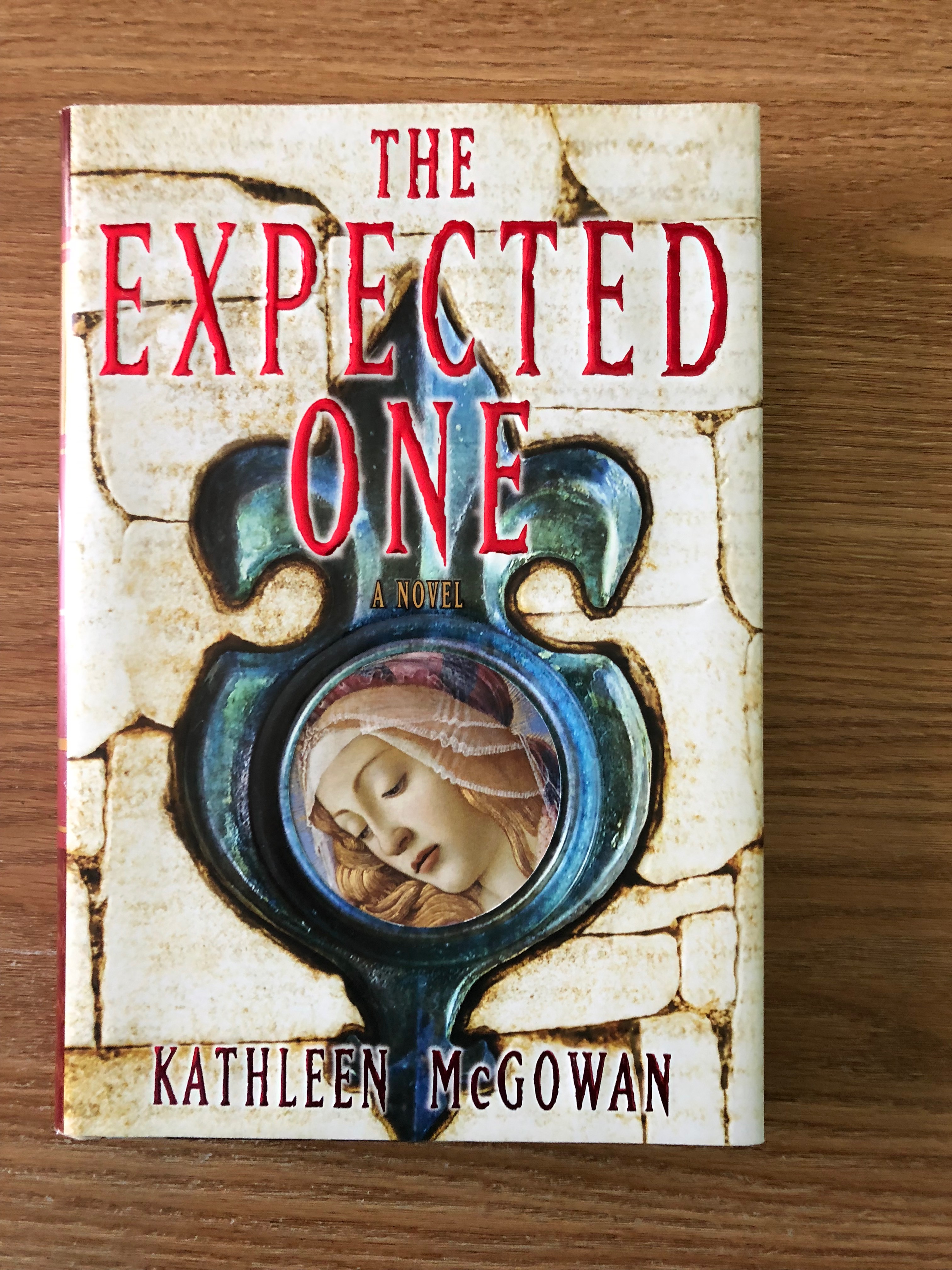
“It took a tremendous amount of courage to write this book … Its portrayal of biblical characters is hauntingly, disturbingly real. I will be forever grateful to Kathleen McGowan for giving me a huge push forward on my spiritual journey by opening me up to a deeper vision of the Divine.” ~ Reverend Jeffrey J. Bütz, Author of The Brother of Jesus and The Lost Teachings of Christianity, writing about The Expected One
Let me say that I loved The Da Vinci Code. However I think enough time has passed since the movie, based on the book, was made that we could stand to see another film using a similar story line. I’d like to suggest that someone translate The Expected One and it’s sequels into films.
As a religious studies graduate, I find reading any novelization of religious history fun. I read The Da Vinci Code first and thought the film was as good as the book. I mean how can you go wrong with Tom Hanks in the lead.
The Da Vinci Code is told from a man’s point of view. It is, for the most part, a murder mystery, action story with two of the three main characters being men. The details of the biblical Jesus are what Alfred Hitchcock would call, “the MacGuffin,” the thing the characters are focused upon but the audience doesn’t necessarily care about. The real center of Brown’s story has to do with the murder of The Louvre curator and why Robert Langdon, a college professor specializing in symbology has been framed for it. Sophie Neveu, a cryptologist for the Paris police, enters to help Robert escape and to solve the mysterious death. She tells Robert that the dead curator was her grandfather and soon they discover that he was a member of a secret society whose mission it is to protect the living descents of Jesus. It’s a compact story taking place within a mere 48 hours.
The Expected One, on the other hand, is told from a woman’s point of view. The story begins when Maureen, vacationing in Jerusalem, has the first of many extraordinary experiences. During these experiences, she glimpses Mary, Jesus, John the Baptist and their relationships to each other that set in motion the events in Maureen’s present day. The book gives more detail about what may have really happened during Jesus lifetime. It asks the question, what if everything we thought we knew about Jesus and his disciples is wrong? Kathleen McGowan takes us not only on a historical adventure, but on a spiritual journey as well. Through her main character, Maureen Pascal, we get a glimpse into the world Jesus and his disciples lived in. Maureen, it turns out, is the The Expected One, foretold in prophecy to find and reveal the long lost gospel of Mary Magdalene. In this book, what is contained in Mary’s gospel drives the action. That is not to say there aren’t deaths and action sequences. But the bulk of the story has to do with Mary Magdalene, and Maureen’s deeply personal spiritual journeys as Maureen follows the clues to find Mary’s gospel. Maureen discovers there are opposing secret societies trying to protect or destroy Mary’s legacy. And included in the story is some interesting history of the Cathars, a mostly forgotten Christian religious sect in France that had a great deal to do with Mary and her children.
Both books challenge what we think we know about the formation of, and teachings of Christianity, and the roles the various historical characters played. In my opinion it’s a good thing to continue to examine our belief systems and try to learn as new information is discovered.
The Dead Sea Scrolls and other ancient documents that have been uncovered in recent decades have added to and even challenged what we thought we knew about the times in which Jesus lived. Maybe wrapping up some of that new information into a fictional package makes it more palatable to consider.
All I know is that when I read the quote above by Reverend Jeffrey J. Bütz on the back cover of The Expected One, I was intrigued enough to buy the book and read it. And as I finished the last page, I too felt a shift in my spiritual beliefs. That’s the reason I’d like to see The Expected One and it’s sequels, The Book of Love, and The Poet Prince turned into movies.
Thanks for reading, liking and commenting. I appreciate it very much.
Lucinda is the author of The Space Between Time, an award finalist in the “Fiction: Fantasy” category of the 2017 Best Book Awards. It’s a historical, time-travel, magical realism, women’s novel, and is available in all ebook formats at Smashwords, or you can find the ebook at iBooks or Barnes and Noble. If you prefer a physical copy, you can find a print-on-demand version at Amazon. To join her email list, click here. She will never sell the names on her list.
“I have often thought it was very arrogant to suppose you could make a film for anybody but yourself.” ~ Peter Greenway
“Books and movies are like apples and oranges. They are both fruit, but taste completely different.” ~ Stephen King
“The book is a film that takes place in the mind of the reader. That’s why we go to the movies and say, ‘Oh, the book is better.’” ~ Paulo Coelho
Maybe it’s because I’m a visual learner, but, in general, I like to see the movie first, then read the book after. Once I’ve seen the movie, I can use images from the film and translate them to the book. I know, most people will think I’m crazy.
Most of the time, descriptions of characters and environments in books are things that don’t create clear pictures in my head. I don’t dream in clear pictures, or color either. What I connect with are the emotions of the characters. If I’m not connected to the characters emotionally, I don’t continue to read the book, or watch the movie, or TV show.
Having written that, there are books I’ve read that I would love to see made into movies, or a series, because I want to SEE the countryside, or what someone else thinks the characters look like. It’s probably my many years doing theatre that makes me want to turn my favorite books into a visual representation.
Some years ago, I read a wonderful book titled, His Majesty’s Dragon by Naomi Novik. Novik is a historian, and the book, which is the first in a series, takes place during the Napoleonic Wars. Most of the events are historical with a little twist. The combatants each have an aerial corps made up of dragons, and the captains they choose to bond with.
In fact, that is what happens in the first pages of the first book. An unusual dragon egg has been confiscated from a French frigate by the British ship, Reliant. When it begins to hatch, the Captain, William Laurence, asks for a volunteer from among his officers to bond with the dragon. But, in inscrutable dragon fashion, the hatchling Temeraire, chooses Laurence as his companion and captain. This thrusts Laurence into a completely unfamiliar world. The aerial corps is not a particularly prestigious posting, nor do the airmen and women, like interlopers. Most of them have been part of the air corps most of their lives and some are part of long generational lines in the service. The dragons live very long lives and not only bond with a single person, but their captain’s children as well. Having been chosen, though, Laurence can not refuse and dragon and man begin a fascinating journey together.
His Majesty’s Dragon is the beginning of a nine book series. There are book series that I’ve started and after three or four books, I get bored, but I was hooked on these books. They are extremely well written, Laurence and Temeraire travel the world, betray Britain in order to save French Dragons from a plague, win their country’s trust back, begrudgingly, when it is discovered that Temeraire is a rare Imperial dragon from China. This later requires the Chinese Royal family to adopt Laurence as a Chinese prince since Temeraire will have no other companion. This does gain the Britain a valuable ally to help fight against Napoleon. In the end, Temeraire and Laurence play a major part in winning the war.
Another thing I love about the series is that Novik has elevated certain women to be part of the aerial corps. They are intelligent, strong, capable, and do not adhere to the standard roles other women were supposed to fill during the time period. In fact, the Admiral over all of Britain’s aerial corps is a strong woman who’s daughter is part of Laurence’s crew, and who has an intimate relationship with Laurence when they can manage to be on the same continent, or hemisphere.
Mostly, I’d love to see this series made for TV or movies because of the enduring relationship that develops between Temeraire and Laurence. Novik has created dragons who are intelligent, for the most part have extensive educations, and who have very distinct personalities. They help strategize for battles, and maneuver through difficult political situations. And, the British dragons at least, must also overcome fear and prejudice. I think these books would add to the interesting array of series like Game of Thrones, Outlander, Vikings, and the like.
I’d like to know what books you’d like to see turned into movies. I’m always interested in authors and books I’ve never heard of. My TBR list is very long, but I’m willing to add to it.
Thanks for reading, liking, and commenting. I appreciate it. Have a fun filled weekend.
Lucinda is the author of The Space Between Time, an award finalist in the “Fiction: Fantasy” category of the 2017 Best Book Awards. It’s a historical, time-travel, magical realism, women’s novel, and is available in all ebook formats at Smashwords, or you can find the ebook at iBooks or Barnes and Noble. If you prefer a physical copy, you can find a print-on-demand version at Amazon. To join her email list, click here. She will never sell the names on her list.
An image of the Kunta Kinte Alex Haley Memorial in Annapolis.
“It is impossible to kill an enemy. You may end a man’s life, but his son become your new enemy. A warrior respects another warrior, even he is his enemy. A warrior kills only to protect his family, or to keep from becoming a slave. We believe not in death, but in life, and there is no object more valuable than a man’s life. The way of the Mandinka is not easy but it is best.” ~ Kintango to Kunte Kinte in Roots
“My fondest hope is that ‘Roots’ may start black, white, brown, red, yellow people digging back for their own roots. Man, that would make me feel 90 feet tall.” ~ Alex Haley
I vowed when I went to college that I was not going to watch any television because I was a TV addict. So there are lots of TV series that started during those years that I never watched, but I broke my vow when Roots was broadcast in 1977. It was a television event. Almost all the households in the nation were tuned into the series which was based on the book of the same name by Alex Haley. I vaguely remember lots of young women huddled around the TV in the dorm lounge. The series was the topic of lots of discussions in classrooms, the student union, and the commons at meal times. We needed that discussion then, and we need it now.
It’s hard to talk about how deeply I was affected by that series. My heart was wrenched and broken during many of the episodes. I didn’t understand how whites could think it was okay to enslave blacks and treat them with such cruelty. And yet, through the seven generations of Kunte Kinte’s descendant’s story, there was hope, perseverance, and dignity in the face of the most horrific situations. One of the things I got out of both the book and the series was that freedom is a state of mind. Many of the characters in Haley’s story discover this. They pass this down through the generations of their family and in the end they are able to prosper.
I loved the series so much that I bought and read the 729 page paperback version of the book. Reading it was at times harder than watching the series because of the descriptions, especially the sections on the ship. How anyone could survive the lack of food, clean water, the filth and laying packed so tightly one prisoner to another in the hold with very little fresh air and exercise, comes down to the human will to survive. But the book is about human tragedy. It shows not only how slavery affected the slaves, but their masters too. The masters were not exempt from the tragedy of slavery because the book shows how their humanity was eroded as they ignored the worth of those they were torturing and enslaving.
Slavery and the way we continue to treat blacks, and people of ethnic groups other than white, is something we need to acknowledge and examine not once, but over and over again until we learn that every human being is worth being treated with dignity and respect. The 1977 version of the Roots series was one point in history when we faced a wound in our county’s history that needed to be healed. But after the hubbub died down, we forgot and went back to our comfortable corners. I was happy that another version of the series was produced in 2016 for a new generation and the self-examination started all over again.
Even though both series were great and generated lots of viewers and discussion, I think reading the book is a must. The way Alex Haley wrote it put me into the minds of the characters, particularly the black characters, and made me feel what they were experiencing. A book that can do that, changes the perspective of the reader. It certainly did mine. Years later I was teaching special ed. English, and I decided to read Roots to the students near the end of the school year. I wept again as I read the chapters that took place on the passage to America. The students were just as affected as I, and some even wept with me. That confirmed my conviction that anything that can help us see the world from someone else’s point of view is good.
If you haven’t read Roots, or seen either of the series, I suggest you do, because we’re at another one of those seminal moments in our country’s history, when we need to take a step back to do more self-examination and healing.
Thanks for reading. I appreciate your likes and comments.
Lucinda is the author of The Space Between Time, an award finalist in the “Fiction: Fantasy” category of the 2017 Best Book Awards. It’s a historical, time-travel, magical realism, women’s novel, and is available in all ebook formats at Smashwords, or you can find the ebook at iBooks or Barnes and Noble. I you prefer a physical copy, you can find a print-on-demand version at Amazon. To join her email list, click here. She will never sell the names on her list.


 Sage Woman Chronicles