To Kill a Mockingbird

To Kill A Mockingbird book cover

“If you just learn a single trick, Scout, you’ll get along a lot better with all kinds of folks. You never really understand a person until you consider things from his point of view… Until you climb inside of his skin and walk around in it.” ~ Atticus Finch in To Kill a Mockingbird

I know it’s St. Patrick’s day and I should be writing about A Tree Grows in Brooklyn, or some other book about Ireland, or the Irish experience in America, but I haven’t finished reading Tree yet so that will have to wait for another post.

Instead, I have a confession to make. I did not read To Kill A Mockingbird until about two years ago. I know! How come I was not required to read it in school? Well, perhaps since I had just started elementary school when the book came out in 1960 and the movie came out two years later, it hadn’t become an American icon quite yet even though the book won the Pultzer Prize for literature. So, I was introduced to this amazing story by the movie.

It was probably on one of those Sunday Night at the Movies programs that were so popular back in the dark ages when there were only three TV networks. They were TV “events” showing recently released movies that had received lots of acclaim. The movie won three Oscars and was nominated for five more.

The Sunday Night at the Movies program was a godsend for our family since we lived in a series of small towns most of them with no movie theater. To Kill a Mockingbird became one of our family favorites. Whenever it was on TV ever after, I would watch it sometimes with other family members. But most often I watched it with my father. He and I would discuss the characters, events and main ideas. Loving the movie so much, it’s hard even for me to believe it took so long for me to read the book.

I can’t really say why I never felt compelled to pick up the book. It might be partly because the character of Atticus Finch was so much like my father, the way he interacted with his children was so much like the way my father interacted with my brother, sisters, and me. Or maybe it’s because I don’t understand Southern sensibilities. I grew up in the Pacific Northwest where the outlook on life is very different. I’ve read a number of books about the south and I don’t understand the long held beliefs and emotions that divide classes and races. But, in truth, I think that has more to do with the way I was raised than where I grew up. No matter what the reason, I’m so glad I finally got around to reading the book.

I have another confession to make. To Kill a Mockingbird was the movie that began my life long love for Gregory Peck. There was some core of goodness about him, and most of his characters, no matter how troubled they might be that was reflected through to the audience. I love his work so much that I made sure I got an autographed photograph of him at an International Thespian Festival I attended years ago. That photograph hangs on my office wall above a photo of my father.

Just now as I write this I realize that I didn’t want to spoil the image of Atticus I got from the movie, just in case the book and movie characters were different. I was relieved that Atticus retained the same characteristics in the book that I had so loved in the movie.

Several years ago, when I was teaching high school, I was given the opportunity to acquire a course called The Story of Movies, produced by The Film Foundation in partnership with IBM and Turner Classic Movies. The course is designed to help teachers and students understand how to identify the language of film so they can get the most out their movie going experience. The first of what was supposed to be a series used To Kill A Mockingbird as the source material. There were two things I learned from teaching the course that helped me appreciate this beloved movie even more.

The first is that everything that is in a movie, whether it is part of the setting, costumes, music, or even the opening credits, has a purpose. In a way the audience is receiving subliminal information in every frame of a film. The second is what I pointed out before, the camera shows the audience what to focus upon.

The Story of Movies video and materials pointed out something I had not thought about before. Opening credits are important, especially for older movies, and particularly for this one. The camera focuses on a child’s hands opening an old cigar box while she is singing. She takes out each one of the things in the box. As the credits continue the movie theme music begins underneath the images. All the things that are shown in the box during the opening credits are things Jem shows Scout later in the movie. If you are an avid movie fan, those kinds of details are the extras that enhance your movie watching experience.

There is one scene in the movie that I find extraordinarily moving. It’s the scene after Tom Robinson’s trial is over. Everyone has left the courtroom except Atticus and the black spectators in the upper gallery. As Atticus leaves, they stand up as a show of honor for his efforts to save Tom. The camera takes in the wide shot so we see both Atticus and the people standing. Atticus doesn’t look up to acknowledge their tribute. My throat closes up every time.

There have been times when I felt like I didn’t have the right to weep at this moment because I’m a white woman. I think it’s sad that the black people of Macon are thought of as second class citizens, so much so that even a poor white family is held in higher esteem than they are. It’s such a complicated moment. I always think that Atticus can’t look up because of all the history that divide whites and blacks in his community, or maybe it’s because he doesn’t want to embarrass them, or maybe it’s because he feels that he should have done a better job of defending Tom, or maybe he’s ashamed of the whites in his town for upholding the status quo. All those feelings affect me. I just want the white and the black people to be able to have a clean, open relationship, but for whatever reason, they can’t.

As I said, I felt guilty about my emotion over that moment, until I listened to an interview with a black actor, I think it was with Laurence Fishburn. He nearly wept as he told the interviewer how that same moment in the movie makes him weep every time. He listed the same reasons that affect me so deeply. I felt vindicated. And what he said made me think that no matter how I’m affected by art, that’s a good thing. I should never feel ashamed of expressing my true emotions.

So often we apologize for showing deep emotions, even in our most private moments. When something touches me so deeply that I cry, I feel extremely vulnerable. But it’s in our most vulnerable moments that we have the best opportunity of connecting with others. We don’t apologize for laughing, why apologize for crying? Having come to that conclusion, I’ve vowed not to apologize ever again for weeping when I’m in public.

To Kill a Mockingbird is one case in which the book and the movie are essentially the same. Some of the events and characters are condensed or emphasized differently, but the core message is universal, loving and caring for each other no matter what the circumstances, is extremely important.

Thanks for reading, liking and commenting on my posts.

I hope you have a fabulous weekend.

Lucinda Sage-Midgorden © 2018

Lucinda is the author of The Space Between Time, an award finalist in the “Fiction: Fantasy” category of the 2017 Best Book Awards. It’s a historical, time-travel, magical realism, women’s novel, and is available in all ebook formats at Smashwords, or you can find the ebook at iBooks or Barnes and Noble. I you prefer a physical book, you can find a print-on-demand version at Amazon. To join her email list, click here. She will never sell the names on her list.

More Cloud Atlas

“If God did create the world, how do we know which things we can change and which things must remain sacred and inviolate?” ~ David Mitchell, Cloud Atlas 1850 timeline

“We cross and recross our tracks like figure skaters …” ~ David Mitchell, Cloud Atlas 2012 timeline

“Our lives are not our own. From womb to tomb we are bound to others past and present and by each crime and every kindness we birth our future.” ~ David Mitchell, Cloud Atlas 2044 timeline

The reason I watch movies, is the same reason I read books. Because I want to learn something. I want to see life through someone else’s eyes. I want to see how other people face their challenges and learn (or don’t learn) from their mistakes.

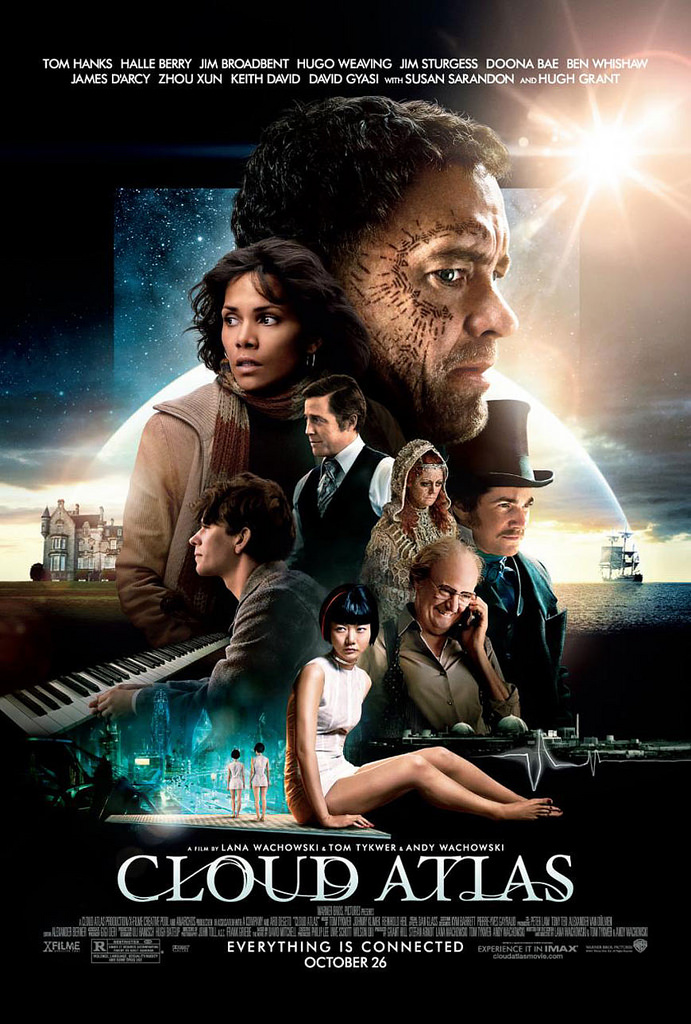
In the last post I didn’t get to write as much as I wanted to about the movie adaptation of Cloud Atlas and why it made me want to read the book. One of the things I love about both the book and movie is the idea that every life is important no matter how small. And that each soul has the opportunity to grow and progress as they live through many lifetimes.

If you’re an avid reader you know that authors have more leeway, in terms of how they tell their story, than movie makers do. This has always been obvious to me, but I’m surprised at how many people don’t seem to understand that movies and books are different forms of art. A movie is approximately two hours long. So unless you’re creating a mini-series in which you can include more plot points, the screen writer and director must choose the parts of the book that are most relevant to the main idea and leave the rest behind.

Probably the most important short cut to movie storytelling is the use of the camera. It is showing the audience what to pay attention to. Of course, I didn’t realize this when I first began watching. The camera is the omniscient point of view. Sometimes it zooms in on things we’re supposed to notice, or it spins, or shows us a scene from a great height.

When I saw Cloud Atlas for the first time, I knew enough by then to pay attention to what the camera wanted me to notice. When it focused on a comet shaped birthmark on the main characters in each timeline, I knew that was an important plot point. But it wasn’t until the third time this happens in the 1973 storyline, that I began to understand why. Sixsmith, a character we first meet in the story in 1936, comments on the birthmark on Luisa’s shoulder and tells her that he once knew someone with a very similar mark. That’s when I got the idea that this mark is not only telling me who the main character of that timeline is, but that perhaps each new body with the birthmark is inhabited by the same soul.

The idea of reincarnation is subtly reinforced by the fact that the filmmakers use the same actors to play various characters in many of the timelines. In some storylines, a man will play a woman, or visa versa, or they will play a person of one race in one storyline, then a person of another race in another. Once I identified the actors and the roles they played in each storyline, it was interesting to see if that “soul” evolved or not.

One of the strongest ideas of both the book and the movie are the opposing viewpoints that indicate the main theme. The first is a more crude version of a very old idea, “The weak are meat, the strong do eat.” Several characters state this idea in various ways throughout the movie, while other characters oppose this point of view stating that love, truth, and compassion are all more important. I think readers and movie audiences are led to ask “What is true strength? Are the powerful more important than the weak?” We get the answer as each main character is triumphant in their particular timeline.

Adam Ewing’s story from the 1849 timeline sums up the theme in the most profound way. Adam, after arriving home to San Francisco from a mission to acquire slaves for his father-in-law, informs him that he and his wife Tilda are going East to work in the Abolitionist movement. His father-in-law goes on a long tirade, “… Naïve, dreaming Adam. He who would do battle with the many-headed hydra of human nature must pay a world of pain and his family must pay it along with him! And only as you gasp your dying breath shall you understand, your life amounted to no more than one drop in a limitless ocean!” To which Adam replies, “Yet what is any ocean but a multitude of drops?”

That idea makes me weep. There are so many people who think their life means nothing in the grand scheme of things. But we all make contributions to human evolution, even those of us who are considered evil make a contribution, because those are the ones who compel us take a good look at ourselves. And hopefully we say, “I’m not going to be like that! I’m going to be better.”

Cloud Atlas is not the first book or movie to show us that every single person’s life is important even if the names of those people are forgotten by future generations. That’s what I loved about the movie. It’s THAT idea that made me want to go read the book. Both mediums made me feel like I have a contribution to make to the world no matter how small. And I’m the one who decides what that contribution will be.

I hope you find great movie/book connections that inspire you. I believe that reading books and watching movies are wonderful ways to gain a greater understanding about what makes us human.

Thanks for reading. I appreciate your comments and likes.

Lucinda Sage-Midgorden © 2018

Lucinda is the author of The Space Between Time, an award finalist in the “Fiction: Fantasy” category of the 2017 Best Book Awards. It’s a historical, time-travel, magical realism, women’s novel, and is available in all ebook formats at Smashwords, or you can find the ebook at iBooks, or Barnes and Noble. If you prefer a physical book, you can find a print-on-demand version at Amazon. To join her email list, click here. She will never sell the names on her list.

Movie/Book Connections

“Adaptation seems to be, to a substantial extent, a process of reallocating your attention.” ~ Daniel Kahneman

In my last blog post I wrote about feeling restless. That feeling hasn’t gone away completely, but I think I may have hit on a new direction I want to take with these posts. The idea came to me as I was listening to my favorite podcast, “What Do I Read Next”. Almost every guest Anne Bogel has on her show has a unique perspective about books. Some of them have created interesting businesses based on one thing they are interested in that are related to books and writing. I have found every one of Anne’s guests to have an interesting story to tell about what books mean to them, how they choose the books they read, how they organize their libraries, or how books have helped them find friends.

As I was listening to this week’s episode that little bit of inspiration I was asking for came to me. I have always loved movies. When I also became an avid reader, often a movie based on a book would grasp me so deeply that I wanted to read the source material. That is my preferred way to do it, see the movie first and then read the book. However, it’s okay if it happens the other way too, like when I read the Harry Potter series then saw the movies. I know enough about the movie making process that I can forgive not having my favorite book scenes included in the movie.

Thursday night I showed my dramatic structure class the movie, Cloud Atlas. It’s one of my favorites and happens to be one of those movies that sent me searching for the book. The movie had some mixed reviews because it weaves six timelines in and out of each other. Many people found it confusing. The book also has six timelines. The first story which seems to be a historical story, begins in 1849 and abruptly ends in the middle of a sentence. The book then picks up with a gay love story that takes place in 1936, then a mystery in 1973, a comedy in 2012, a dystopian science fiction in 2044 and finally a kind of hopeful fantasy/sci-fi story at the center which takes place in the far future. Once that last story is told, the book continues with the 2044 timeline and the plot moves backward through the timelines ending with the 1849 story. If the movie were structured that way, it would most likely be boring.

One thing I’ve learned by osmosis, and from taking a few film classes is that there are lots of techniques that film makers use to help the audience understand what’s going on. Most of the time we don’t notice the camera angles, shot lengths, details of the setting, costumes, props, lighting and music that give the audience clues about plot and characters. There are also little snippets of dialogue that seem to be offhand, but later play a big part in the plot. The screen play has to pair down the book plot, and as in the case of Cloud Atlas must be structured differently to tell each timeline’s story in an interesting way.

Maybe that’s what I find so fascinating. Movie makers take a book and select the most important parts of it to convey its message to an audience. To do that they use all sorts of visual cues to help us connect emotionally to the characters and story. In my mind, if a movie team succeeds and makes a fabulous movie, that makes me want to go to the source material to see how the movie compares with the book.

I wrote all of the above to say that I’m thinking of writing more posts about movie/book connections that have been both enjoyable and sometimes life changing for me. After telling Barry, my husband, about this idea I began to make a list in my head of all of the movies and mini-series that have inspired me to go find the book. The list is long and varied. Some movies are classics like Ben Hur, or The Valley of Decision, while others are modern retellings of classic novels, still others are based on contemporary books. I was also surprised to find how many different genres are represented in my list.

This project is going to take a long time but I’m looking forward to sharing my favorites with you from time to time.

Thanks for reading. I appreciate your likes and comments.

Have a fun weekend. We’re off to see Black Panther. Who knows maybe I’ll begin reading graphic novels next.

Lucinda Sage-Midgorden © 2018

Lucinda is the author of The Space Between Time, an award finalist in the “Fiction: Fantasy” category of the 2017 Best Book Awards. It’s a historical, time-travel, magical realism, women’s novel, and is available in all ebook formats at Smashwords, and print-on-demand at Amazon and other fine book sellers. To join her email list, click here. She will never sell the names on her list.

Ready for a Change

“And the day came when the risk to remain tight in a bud was more painful than the risk it took to blossom.” ~ Anaïs Nin

“To put meaning in one’s life may end in madness, But life without meaning is the torture Of restlessness and vague desire-it is a boat longing for the sea and yet afraid.” ~ Edgar Lee Masters

“We do not grow absolutely, chronologically. We grow sometimes in one dimension, and not in another; unevenly. We grow partially. We are relative. We are mature in one realm, childish in another. The past, present, and future mingle and pull us backward, forward, or fix us in the present. We are made up of layers, cells, constellations.” ~ Anaïs Nin

I’ve been feeling restless lately and ready for something new. One of my character flaws is that I do not understand people who resist change. It’s hard for me to understand living in one place for an entire lifetime, or working at the same job or thirty years, or never learning anything new.

I suspect I love change so much because I got a healthy dose of my father’s wanderlust. He was always looking for a better way to support us, consequently we moved a lot. But I think part of the reason we moved so often was because once dad had learned all he could from one job, he was ready to move on and learn something new. I’m feeling like that now. I’ve been teaching at our local community college for nine years and I’m ready for some new ideas or even a change of job.

When I got the idea to direct Measure for Measure I wanted to do it because I had never directed a Shakespeare play before. As I began working on it, I had a strong feeling that this was my swan song at Cochise College. I don’t know if this is true but I’ve got that feeling of wanderlust. I want to write in a new genre, take a class or two in subjects I’ve never tried before, go on vacation to a new location, or … I don’t know. I’m waiting for inspiration!

Even though I love changing career directions, or creative projects often, sometimes I envy people who have one focus for their lives. They have one thing they are interested in doing and they spend their entire lives learning and working in the same field. It must be satisfying to dig deeply into a subject always learning something on an ever deeper level.

I guess I’ve done that with theatre and hope to do that with writing too. The arts, or any kind of creative endeavor is like that, the creator never stops learning. Since that’s true, maybe my restlessness is not so much about careers, but something else. A stirring of some kind at a soul level, something whispering to me to break out and try something new.

Maybe I’ll finally learn Spanish or go on vacation, or meet some new people, or I just don’t know. I hope this next week during spring break, I’ll get a clue.

Thanks for reading. I appreciate your comments and likes.

Lucinda Sage-Midgorden © 2018

Lucinda is the author of The Space Between Time, an award finalist in the “Fiction: Fantasy” category of the 2017 Best Book Awards. It’s a historical, time-travel, magical realism, women’s novel, and is available in all ebook formats at Smashwords, and print-on-demand at Amazon and other fine book sellers. To join her email list, click here. She will never sell the names on her list.

One Drop in the Ocean

“Yet what is any ocean but a multitude of drops?” ~ David Mitchell, Cloud Atlas

“… for the growing good of the world is partly dependent on unhistoric acts; and that things are not so ill with you and me as they might have been, is half owing to the number who lived faithfully a hidden life, and rest in unvisited tombs.” ~ George Eliot, Middlemarch

“A leader is best when people barely know he exists, when his work is done, his aim fulfilled, they will say: we did it.” ~ Lao Tzu

“I am the light of the world. … Humility consists of accepting your role in salvation and in taking no other.” ~ A Course In Miracles, Lesson 61

I’ve been feeling overwhelmed this last week or so. It’s a busy semester. I’m teaching three classes and one of them is a play production. It’s been difficult to keep up with my writing projects on top of the teaching duties. I’m not good at multi-tasking so I’ve been putting a lot of pressure on myself to do everything required and do them all well.

When I get stressed I begin comparing myself to other people. Social media is full of invitations to join this or that class or workshop so you can learn the secrets to this or that process that will make your life easier, or make you more prosperous, etc., etc., etc. Seeing those makes me crazy, because I’m tempted to think that I need to be different than I am in order to be a complete person. I need to be an extravert, I need to reach my audience, I need to … Ack! I’m so tempted to let those outer voices become my inner voices but I was saved these last couple of days from those thoughts by two things.

First, I just finished reading Ursula K. Le Guin’s book The Left Hand of Darkness. One character in particular, Estraven, sacrifices his career, his reputation, and his life for Genly Ai, an Envoy from another planet. His mission is to establish ties between Estraven’s planet and an alliance of planets he belongs to. Estraven is the only one on his world unafraid of the arrival of the alien Envoy. He sees that joining this group will be good for the backward governments on his world. Estraven was one man who made a difference by allowing his title and wealth to be stripped from him for a greater cause. Not many of his people knew the full extent of what he did.

The other thing that helped me was our neighbor. He came by to asked my advice on how to write a book. What! You’re asking me, an amateur, to give you advice? Immediately I felt small and unequal to the task. But I had to admit that I do know a little bit about the writing process.

I always shrink from telling other people how to do things. I mean, what works for me, might not work for them. I know that sounds funny coming from a teacher, but as a teacher I try to show my students all the possible ways they can complete a project or paper and then I let them use their own creative skills to do it. So, that’s what I did with my neighbor. He left happy.

I don’t know why I’m so hard on myself. I’m not alone in that. We are, after all, just one drop in a much larger ocean. We don’t have to fix all the problems that exist. Most of the time we never know the good that comes after us as a result of just living our lives.

Today, I’m taking a day off to relax and recoup. Here is a wonderful song I borrowed from Pam Grout’s blog post by India Arie to sing you into a fabulous weekend.

Lucinda Sage-Midgorden © 2018

Lucinda is the author of The Space Between Time, an award finalist in the “Fiction: Fantasy” category of the 2017 Best Book Awards. It’s a historical, time-travel, magical realism, women’s novel, and is available in all ebook formats at Smashwords, and print-on-demand at Amazon and other fine book sellers. To join her email list, click here. She will never sell the names on her list.