Take a Breath

Deer Visit

“He who puts out his hand to stop the wheel of history will have his fingers crushed.” ~ Lech Walesa

“It’s television’s version of taking a deep breath … a very long, very slow, deep breath. It’s called “Slow TV”, and it’s a smash-hit in Norway.” Seth Doane, CBS Sunday Morning

“Being at ease with not knowing is crucial for answers to come to you.” ~ Eckhart Tolle

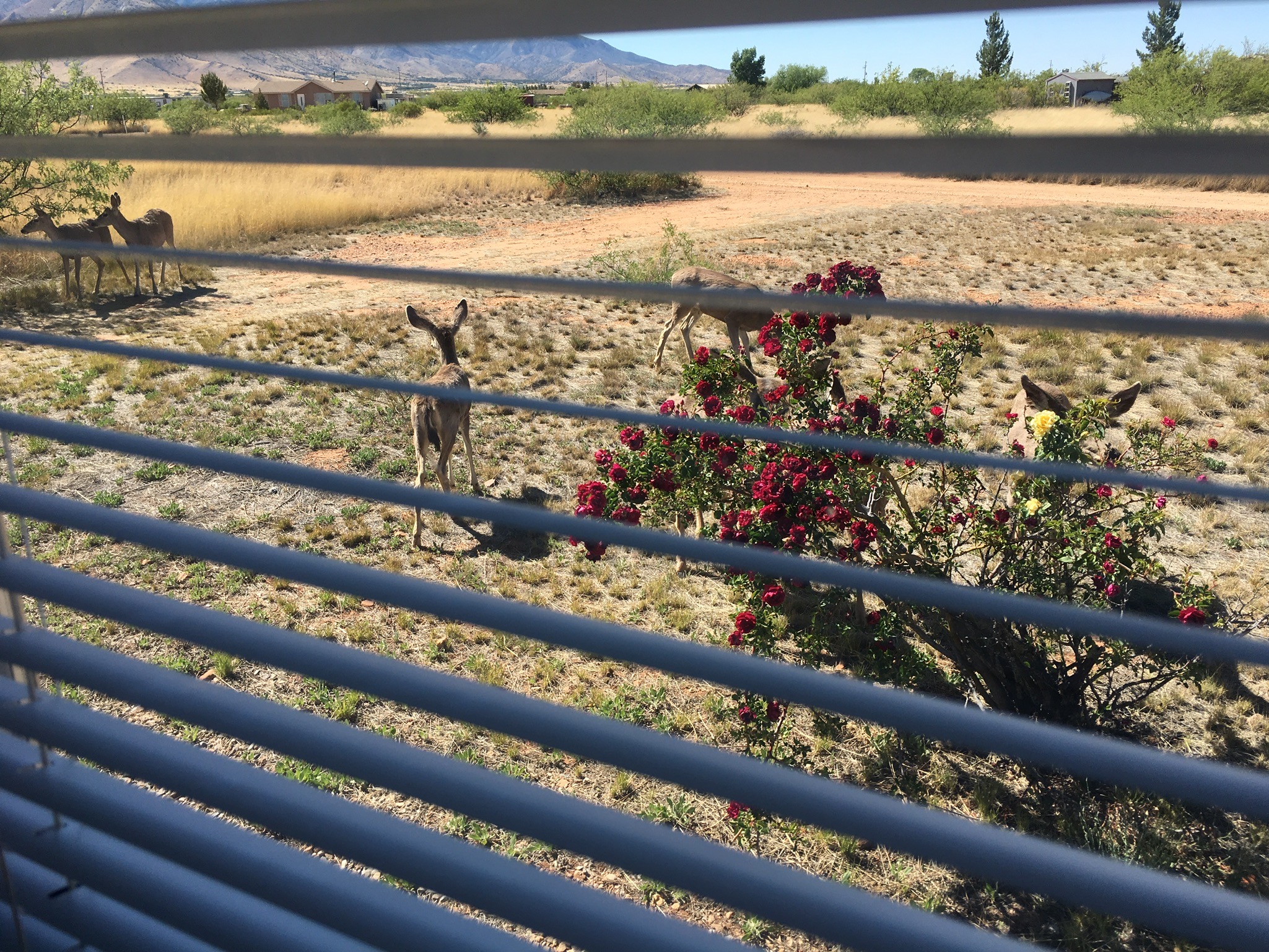
Last Saturday I was working furiously on the latest revisions of my soon (I promise) to be published book, The Space Between Time, when nine deer wandered past my office window. My husband got photos and video of them eating our rosebush. As you can see he had to take them through the blinds of one of our windows. I hope you can see them. We just stood and watched for several minutes as they meandered through the yard eating. I felt more calm after watching them and decided that what I got done that day on my book would be enough.

Then on CBS Sunday Morning there was a segment about a popular show in Norway called “Slow TV”. It is such a contrast to the fast paced life we lead here in the U.S. And I ask myself, do we need to do everything at such a fast pace? Do we rush because we think if we don’t get there first there won’t be anything left for us? That’s pure nonsense. To paraphrase the T-shirt slogan I saw on Facebook, “Life is not a pie.” There is plenty of everything to go around for ALL of us. We don’t have to fight for the crumbs when there is something better waiting for us, if we’d just slow down and focus within.

Maybe it’s because I’m getting older, but I feel a deep need to slow down. I want to appreciate every moment and let the stresses and strains of life take care of themselves. Part of that means reducing the amount of time I check into my social media feeds. If I let them, they can make me crazy with posts pointing out the problems in the world. I don’t want that kind of negative energy in my space. If I can do something about a situation, I will. If not, I trust that there will be people who can help.

So, lately, I’ve been taking deep breaths. I’ve committed to daily meditation, sending Reiki to family and friends and to listening, to nature, other people, and my inner voice. I’m taking some workshops that help me focus on my own spiritual growth and hopefully eventual enlightenment. One effect of this course of action, or non-action, as the case may be, is that I’m feeling happier. I can hear guidance that was downed out by all the noise I was paying attention to, and I can see a happier future for myself with lots of wonderful possibilities. I forgot to do this for a while. I’m glad I got back to just being.

My husband and I are watching Genius, a short series on NatGeo. It’s about Albert Einstein. Once I watched a biography about him, and they shared a story about his process. When he got stuck on the next step in something he was working on, he’d ride the street car and let his mind drift. I do this sometimes when I get stuck on my writing, let my mind drift.

When I was a teacher, I had to drive an hour to get to school. That was often the most productive time of my day, because as my mind was focused on the mundane task of watching the road, the back of my mind was working on a problem I had with a student, or with the play I was directing, or how to present a lesson. I loved day dreaming when I was younger. I think I’ll go back to doing it more often.

I encourage you to get off the merry-go-round that surrounds you for at least a few minutes a day, take a breath, and appreciate the great things in your life. That’s how even greater things come to us. Gratitude and appreciation allows that still small voice to open up worlds that we were not previously aware existed.

Thanks for reading. Feel free to leave a comment or share with a friend.

Lucinda Sage-Midgorden © 2017

Deer Lunch

The Gifts of Restlessness

Apollo Launch

“Restlessness is discontent and discontent is the first necessity of progress. Show me a thoroughly satisfied man and I’ll show you a failure.” ~ Thomas Edison

“No, it’s not dissatisfaction that inspires me to tinker with my songs, it’s just restlessness.” ~ Andrew Bird

“I believe that curiosity, wonder and passion are defining qualities of imaginative minds and great teachers; that restlessness and discontent are vital things; and that intense experience and suffering instruct us in ways that less intense emotions can never do. ~ Kay Redfield Jamison

I once heard a poet tell of her writing process. She’d be out gardening, or maybe doing housework when suddenly she could feel a poem galloping toward her. To capture the poem, she’d have to stop what she was doing and run to get pen and paper before the poem passed her by. Sometimes she wouldn’t get to the paper fast enough to catch the poem and it would gallop on never to return. At other times she would miss the beginning of the poem, so she’d have to catch the tail and drag it back. In those cases, she’d have to write the poem down backwards. I wish I could remember her name. I’d love to read her poems.

This story stuck with me because that’s how I know change is coming. I can feel it coming long before it arrives at my doorstep. A mild restlessness and dissatisfaction with the way things are going in my life are the first indications that big changes are on their way.

This feeling of restlessness applies to all aspects of my life, even writing. I can feel that there is something I’m supposed to write about, but sometimes the horse has stopped to snack on luscious grass and I feel frustrated that I have to wait until the horse is ready to continue the journey. No amount of coaxing works. I have to wait to be able to grasp the entire idea.

Or sometimes I feel restless, like now, because I’m waiting on others to do their part so I can publish my work. Then, just when I’m about to explode with frustration, something will happen and I’ll read an article with a writing tip that I can use to improve my work, and that sends me to do another round of revisions. That happened to me last week. So, while my husband is creating the cover art for The Space Between Time, I’m making minor changes to my manuscript.

The thing about restlessness is that it’s not random. When it sneaks in to my life, it’s telling me something important. It appears when I’ve gotten too comfortable and am about to stagnate, which is never a good thing for any of us. We’re meant to grow and evolve and we can’t do that if we cling to our routines and never venture to try anything new.

Maybe our trip to Portland intensified my current restless feelings. I mean for a couple of years, I’ve been examining my belief systems and attitudes, and working to open myself to new ways of thinking and being. Just these past few months, I’ve decided it’s time for some new experiences. But when we went back to a place we had lived for fifteen years, after being away for nearly twenty-one years, I saw how much the city had changed. I didn’t fit there any longer and that shook something loose in me. I think it shook something loose in Barry too because it feels like our horizons have been expanded.

I’m not quite sure how all these feelings will manifest yet, but I know that for the first time, my dreams for the future are far larger than I’ve ever dared hope for and I’m excited for what comes next.

By the way, I hope to reveal the cover art for my novel soon. The restlessness is fading. I don’t think I’ll have to wait long for the changes that have been germinating to appear.

If you’re feeling restless, take that as a sign that better things are on their way and look for new and exciting things to be presented to you.

Thanks for reading. Feel free to leave a comment or share with a friend.

Lucinda Sage-Midgorden © 2017

Why I Won’t “Resist”

California Coast

“This is one of the great metaphors of life: Move with the flow. Don’t fight the current. Resist nothing. Let life carry you, don’t try to carry it.” ~ Oprah Winfrey

“There are three words that convey the art of living, secret of all success and happiness: One with life.” ~ Eckhart Tolle, A New Earth.

“Life can take care of itself. … Most of us are so used to the idea that we need to control our lives. The notion that life can take care of itself from our awareness seems impossible but the infinite intelligence of consciousness has always been taking care of life.” ~ Deepak Chopra

“I find hope in the darkest of days and focus in the brightness. I do not judge the universe.” ~ Dalai Lama

This has been the longest three months of my life. But it’s been a great time of growth too.

When Trump was inaugurated and the roll-back of all the social services that protect the environment and help people began, I was ready to join the resistance movement. Yet, over the years I’ve learned that when I resist events in my life, I’m more miserable because my problems grow bigger. Resistance keeps me stuck in victimhood and focused on my problems rather than looking for a solution.

I was fortunate to learn this fairly early in my life. When I was in college I experienced a series of life shattering events. During this time, someone suggested I buy a journal, which I did. For the first month or two, or three, all I did was complain. But miraculously one day I wrote, “What am I supposed to be learning from all this?” And that’s when my life began to transform. That question moved my attention from my problems to possible solutions. It helped me begin to examine my attitudes, beliefs, and behaviors that were contributing to my unhappiness.

Change happens whether we want it to or not. It’s like waves lapping up on the shore. We can’t stop them even if we wanted to. I’m not a surfer, but I imagine that to be good at that sport you have to learn to go with the flow. Once you’re up on that board riding that wave, you have to be sensitive to the flow of the water and make adjustments accordingly. It seems to me that if you misread the flow, or the new direction the wave is headed, you fall. But the beauty of surfing is that you can get up and ride the next wave, and possibly end up in a different place from where you began. I think it’s better to go with the flow rather than try to make the water go where we want it to. That never works. And besides, we’re not God. We can’t see the whole ocean. We can either trust the flow of life, or we can cause ourselves all kinds of pain fighting against the current.

For this reason, I trust life to take care of life. Whether we want it to or not progress happens, and right now I think old structures are getting washed away. We’ve fallen into the water and are trying desperately not to drown. We can relax, hold on to the board and let the wave take us safely to shore, or we can yell at the wave and fight to get back to where we fell. It’s our choice.

When I hear the word resistance, I think back to all the times in my life when I resisted growth, or the truth about myself. When I fought, I was miserable. When I allowed myself to feel my true emotions, they dissipated much faster, and I could see solutions that were hidden in plain sight while I was focusing on the problem.

Two weeks ago I joined Oprah and Deepak’s latest 21 day meditation series, “Hope in Uncertain Times.” As they have guided me through these powerful meditations, I have come to understand that the tide of human evolution has turned. Most of us have been shaken from our apathy. We’re finding purpose in standing up for the world we’d like to live in. We’re doing that in big and small ways. The phone calls, and demonstrations are peaceful, but powerful because we know what we want and we’re not giving up.

The contrast between those of who are going with the flow of change, and those who are fighting the current is very apparent. Some of our leaders want to turn back the clock, but that’s impossible. Therefore I have to trust that soon the wave will rush into shore and we’ll see ways to build better systems to replace the old.

Recently a Facebook friend of mine showed me a great way to contribute to the rebuilding process. She shared that her life has been very stressful for some time now. Yet, one day she passed a homeless man sitting on the sidewalk in the rain near her house. It seemed to her that his need was greater than hers, so she made a sandwich and took it too him. She wrote that she was learning to “Give what you can when you can.” Giving that man a sandwich helped her feel better about herself and her situation. I found that inspiring. When she helped that man, her focus changed from her problems to a small solution for someone else. I think I’ll follow her lead, because when more of us do what we can, when we can, we create a larger and larger flow of change. And change, like water, cuts through the hardest substance given enough time.

Thanks for reading. Feel free to leave a comment or share with a friend. To join my mailing list, click here.

Lucinda Sage-Midgorden © 2017

Radical Love

Caring Hands

“I believe in love. Not just getting it, but giving it. I think that if you’re able to love someone, even if they don’t know it, even if they can’t love you back, then it’s worth it.” ~ Dorothy in Gosford Park

“… Now I know she’ll never leave me, even as she fades from view. She will still inspire me, be a part of everything I do. Wasting in my lonely tower, waiting by an open door. I’ll fool myself she’ll walk right in, and as the long, long nights begin, I’ll think of all that might have been, waiting here forevermore.” ~ Beast singing “Evermore” from Beauty and the Beast

“Love recognizes no barriers. It jumps hurdles, leaps fences, penetrates walls to arrive at its destination full of hope.” ~ Maya Angelou

Many years ago I read an amazing book, The Road Less Traveled by M. Scott Peck. That book helped me change my perspective about life and love. Until I read that book I thought that something was terribly wrong with me because I was miserable while everyone else around me seemed to be so happy. I thought their lives were easy. That bothered me because mine was not. Oh, how wrong I was. We all struggle, we all want to live a meaningful life and most especially we all want to be loved.

Peck’s book opened my eyes to a new concept about love. He wrote, “Love is the will to extend one’s self for the purpose of nurturing one’s own or another’s spiritual growth … Love is as love does. Love is an act of will – namely, both an intention and an action. Will also implies choice. We do not have to love. We choose to love.”

Reading that was like a slap in the face. I was so used to trying to get people to love me that I never considered that choosing to love was my responsibility. If I loved myself, loving other people would be easy, and my life would be enriched whether they loved me back or not. But more than that, I understood that I had access to a well of love that I could rely upon whenever I needed it. All the love that has been shared throughout the history of the human race still exists. We can add to it and access it to help us through any challenges we might face.

Many people read The Road Less Traveled. It was on The New York Times Best Seller list for a very long time. I think perhaps Peck’s assertions about love have affected not just spiritual seekers, but artists as well. The kind of love M. Scott Peck talks about in his book permeate movies, books and television shows. Look at some of the latest crop of Disney movies, to name just a few. Maleficent, Tangled, Frozen, Cinderella, and the new Beauty and the Beast. They all have sweet, seemingly innocent, weak characters who are unwavering in their love for someone who needs it, or they are sustained by the love when they need it most. Because of love characters are transformed. But the endings aren’t the artificial, “And they lived happily ever after kind.” In each case, the characters learned important lessons from their trials that will help them the next time challenges come.

And radical love is not a major theme only in Disney movies. It shows up in lots of places in popular culture. One of my favorite places it shows up is in, Gosford Park, written by Julian Follows. He’s one of my favorite screen writers because he conveys important concepts with so few words. The quote above by Dorothy, one of the maids in the country house, Gosford Park, rang so true for me, and reminded me of what Peck had written in his book. Love isn’t a prize. It’s something you cultivate within yourself and give freely to others without expecting anything in return.

The song “Evermore” that I quote above, from the live action Beauty and the Beast has the same sentiment. The Beast is changed because he allows another person into his life. Something about Belle helps him venture to love enough to let her go to do what she needs to do. And as the quote above tells, he will never be the same even if she never returns to him. He has made a decision to uncover the loving person who got buried by an uncaring father. If you haven’t seen this latest version, I highly recommend it. It’s an extremely beautiful movie.

I didn’t realize that love was such an important theme in my own life until I wrote my book, The Space Between Time, I didn’t intend to have a deeply wounded character be transformed by love, at least not consciously. It just kind of happened that way. But when I was writing a pivotal scene, all the things I’ve learned about love since reading The Road Less Traveled, kind of coalesced. Here is a bit of what came out of the computer key board:

“Aris waited a moment or two to see if he would continue. When Seth was quiet, he asked, ‘Do you think you’ll ever tell her what you’ve told me?’

Seth took a deep breath. ‘I have to don’t I? Even if she can’t love me, I must tell her how much loving her has changed my life.’”

It feels like we human beings are waking up to the fact that to have a loving world, we must not SEEK love, but BE love. To me that means to be there for the people who need us, or to leave people who are toxic. We can’t share love if we hate ourselves. Love has to begin within us. I believe it’s the lack of self-love that has caused all the conflicts throughout history.

I’m not sure this post has an end. We are sustained by the love left behind, and If we tend our love, it will only grow larger and stronger. We’ll continue to be transformed by it.

Thanks for reading. Feel free to leave a comment or share with a friend.

Lucinda Sage-Midgorden © 2017

Art is Fundamental

Toucan Snail by Barry Midgorden

“Next to the Word of God, the noble art of music is the greatest treasure in the world.” ~ Martin Luther

“The world is but a canvas to our imagination.” ~ Henry David Thoreau

“Art is not what you see, but what you make others see.” ~ Edgar Degas

“Vision is the art of seeing what is invisible to others.” ~ Jonathan Swift

Many of you know that I have degrees in theatre, I’ve taught English and theatre for many years. And I’m married to an artist. Which means, art of all kinds is extremely important to me. I think it’s important to all of us, though often we don’t know it.

Last night my husband and I watched an episode of Origins: The Journey of Humankind on NatGeo. The episode was about how, beginning with graphic representations, communication helped make humans the dominant species on the planet. It happened as those graphic communications morphed into story telling with words and dance. From there we developed ever more complex ways of communicating with each other until now we can reach anyone on the globe in an instant.

It’s the art left behind on cave walls, in archeological digs, and in ancient writings that help us understand how we have evolved, and how we have stayed the same. Art is communication. As the narrator of Origins, Jason Silva says, “Studies have shown creating art rewires our brain, increasing the gray and white matter in the cerebellum. This increases overall cognitive function.” Creating art helps us understand the intangible undercurrents of human emotion. And because of art we have the ability to get underneath the artist’s skin and experience life from his or her point of view. Because of this, art is fundamental.

I hate it when school districts need to make budget cuts, it’s always the arts that get cut first. As if communicating on deeper levels, is not important. So, I’m against this current push toward STEM education, which stands for Science, Technology, Engineering, and Mathematics. I know that those things are important, but we wouldn’t have any of those disciplines without first having invented art. Art encourages creative thinking because to participate in art is to think outside the limits of what we already know.

I don’t mean to say that scientists and mathematicians are not creative. They can be but they need to be able to do what Picasso says, “The artist is a receptacle for emotions (ideas) that come from all over the place: from the sky, from the earth, from a scrap of paper, from a passing shape, from a spider’s web.” In my limited experience, people who are involved in the STEM disciplines see the world in a particular concrete way and are uncomfortable with ambiguity. Artists love ambiguity because it’s not linear thinking. Ambiguity is where the magic happens, the visions for a better world, and the innovations come from. I believe great scientists use ambiguity too.

I would love it if art were given its due and instead of this push for STEM in education, we included education in the arts as well. We should make our educational model STEAM instead to include all students. Not everyone is suited to think in linear ways. Some of us are out on the edges of human emotion and thought. We see things others may not even have a clue exist. I don’t want us to leave those students behind as if they’re not important. After all, how many novels, movies and TV shows have predicted, or caused future inventions. I don’t think it’s an accident that the novels, 1984 and The Handmaid’s Tale are flying off the shelves during these turbulent times. Those and many authors, felt the coming of dark times and wrote about them. Some of them envisioned solutions that have little or nothing to do with mathematical equations, building structures or proving new scientific theories.

It takes all kinds to make this world a better place, and to paraphrase Winston Churchill, if we don’t appreciate art, then what’s the use of all the struggle? It’s the beauty of the flowers, the sunrise, or sunset, the fluidity of the moving human body, the smile on the face of another, the colors of the painting, or the words or music that touch our heart and make life worth living. Jason Silva also said on Origins, “No human society has ever been found without music. It lies at the core of our culture.” So, it is art that touches our souls and help us appreciate each other. That’s where the next innovation needs to take place, in our hearts. We can have all the fabulous gadgets in the universe, but what good are they if we are fighting with each other and destroying our planet?

I didn’t mean to get so philosophical. It’s just that as I develop as a writer, I’m able to express that I’ve felt for a long time that we humans sometimes get our priorities mixed up. We think that art is a frivolous thing, but without art, we never would have evolved to where we are now. I know from experience that every time I see a movie, or a play, read a book, listen to music or see a painting, my point of view about the world is altered. I can’t say that about seeing a mathematical theorem. That might happen when I see great architecture, but then again, an artist had to create the design for the building. It seems to me without art, STEM might never exist.

Thanks for reading. I hope you leave a comment or share with friends and family.

If you’d like to join my email list click here.

Lucinda Sage-Midgorden © 2017