Will It Matter in a Hundred Years?

Dad’s Birthday

“Life is 10% of what happens to you and 90% how you react to it.” ~ Charles R. Swindoll

“Lighten up, just enjoy life, smile more, laugh more, and don’t get so worked up about things.” ~ Kenneth Branagh

I had no ideas about what to write today so I asked for help from the writing muses and what kept coming to mind was something my father used to say when I would get upset about something trivial. “Will it matter in a hundred years?”

It invariably happened when I was younger, I’d get caught up in some silly drama and I’d chew on it and make it my mantra. Now I’m not so prone to getting upset. If I do it takes me a much shorter time to get a better perspective. From what I read on social media, there are plenty of people who have not learned that lesson yet.

Yesterday I was looking at Facebook and there was a discussion on the TCM (Turner Classic Movies) group about whether or not The Texas Chainsaw Massacre, which was shown on the station, was a classic movie. It’s amazing how heated these discussions can get over something I consider to be trivial.

Sometimes arguments happen and insults are traded over things that are not so trivial. But here’s what I think my father was trying to get me to see. Our emotions have vibrations. When we get upset and lash out in anger, those feelings don’t stop with the person we’re attacking. Oh, no. They are like ripples in the water. They keep spreading out bashing into other people and affecting them. Have you ever walked into a room where two people have been fighting? Most likely, even if you’re not highly sensitive, you can feel the tension.

Another point my father was trying to make was that I needed to pick my battles. Some situations need to be challenged because in a hundred years we want that situation to have changed for the better.

When something happens that gets us all riled up, we have to take a good look and decide if getting angry, or standing up for ourselves will make a lasting difference or is of no consequence at all.

I just read Earthsea: A Wizard of Earthsea the first in a series by Ursula Le Guin. (I’m giving you fair warning of a big spoiler here in case you haven’t read it yet.) In the book a young wizard, trying to impress a rival at his wizard school, unleashes a deadly dark shadow. He must find a way to vanquish it to save all of Earthsea. To do this he must name it so he can bind it and send it back where it belongs. In the end, after first running from the shadow, then chasing it, he confronts it and calls it by his own name which reunites him with his shadow. He emerges a much wiser young man.

We all have shadows. If we try to deny them, or get rid of them by spewing them all over other people, we help neither ourselves nor others.

This is what I’ve learned from all the lessons my father taught me, it may be difficult to do, but in the end it’s worth it to take a step back to examine whether or not some ripple in the current of our lives is important enough to swim against. Clearly there are situations where going against the stream will eventually change the flow of the water. But often an argument is not worth the effort and in a hundred years, or even next week, no on will remember what the fight was about, nor will it have made the world a better place.

Now I’ve got to go see Earthsea the mini-series so I can write about it in more detail. I will, of course be reading the rest of the series so more to come.

Thanks for reading, liking and commenting.

Lucinda Sage-Midgorden © 2018

Lucinda is the author of The Space Between Time, an award finalist in the “Fiction: Fantasy” category of the 2017 Best Book Awards. It’s a historical, time-travel, magical realism, women’s novel, and is available in all ebook formats at Smashwords, or you can find the ebook at iBooks or Barnes and Noble. I you prefer a physical copy, you can find a print-on-demand version at Amazon. To join her email list, click here. She will never sell the names on her list.

I Want to be Like Pollyanna

“When you look for the bad in mankind, expecting to find it, you surely will.” Pollyanna reading a quote by Abraham Lincoln from her locket in Pollyanna

“We looked for the good in them, and we found it, didn’t we?” Reverend Paul Ford in Pollyanna

Since my play is finished and the semester is nearing an end, I want to resume my series on movie/book connections. I’m choosing an old movie from my childhood because it was only a few years ago that I read the book that the movie was based upon, and it’s sequel. I’m in love with Pollyanna’s outlook on life even more since reading the books.

The movie Pollyanna (1960) made by Disney, came out when I was a child. It takes place at the turn of the 20th century. I fell in love with Pollyanna and all the characters she encounters. In a way it was odd to watch Hayley Mill’s movies because lots of people told me that I looked like her. I didn’t believe them, but I liked being compared to her because I was a Disney fan.

In those days Disney movies were mostly about family situations, lab experiments gone wrong, and cars with minds of their own. Many of them seem outdated now but not Pollyanna. In fact, I think we need more Pollyanna’s now more than ever.

What I loved about the movie as a girl, was that even though Pollyanna’s parents had died, she carried on their teachings to find the good in every situation and to show kindness and respect to everyone she encountered. Those two principles, taught by my own parents, helped me through several moves, lots of challenging situations, and meeting lots of new people.

Some might say this Disney movie is dated too, but I disagree. When Pollyanna arrives at her aunt’s hometown, it’s a pretty dismal place. Her aunt is cold and not happy about being saddled with her niece. She’s the richest woman in town but she’s unhappy and everyone is affected by her need to control everything. By contrast, Pollyanna is poor. She wears hand-me-down clothes because her father was a missionary. She has no outward reason to be joyful, but it’s what she learned. We never see her grieving for her parents. That may be one fault of the movie, but perhaps her determination to see the good in every situation is her way of coping with their deaths. And she spreads her joy, love and positive outlook on life wherever she goes transforming the town and eventually her aunt.

I can’t remember what it was that made me pick up the first book a few years ago. It certainly wasn’t seeing the movie again. It’s rarely played anywhere any more. It may have popped up as a free book on one of my e-book apps. In any case, I was delighted to find that there are two books. I promptly read them both. As always some details of the movie script were changed from the book, but essentially the characters are the same. Pollyanna faces some tough challenges, like the accident that nearly takes the use of her legs, but she manages to face her fears and remain positive throughout the two books. In the end, she finds love and fulfillment by helping others change their outlook on life. And isn’t that what most of us would like, to leave a positive legacy?

These past weeks I’ve found it hard at times to maintain a positive attitude. Maybe that’s why memories of Pollyanna flitted through my mind as I was trying to decide what movie/book connection to write about next. I don’t know why I, and so many people I know, fall into negative thought patterns. It’s not a happy place to live and a hard habit to break. But it can be done one little rainbow maker, one moment appreciating the beauty all around us, and one attempt to help someone else at a time.

So many of the spiritual teachers I follow say that every minute of every day we get a chance to start over. That’s what Pollyanna says too. Find something to be glad about in every situation. Thank you Eleanor H. Porter for writing such a lovable character who reminds us that we are in control of one major thing, how we perceive the world. And that makes all the difference.

Thanks for reading, liking and commenting. Make today a happy one.

Lucinda Sage-Midgorden © 2018

Lucinda is the author of The Space Between Time, an award finalist in the “Fiction: Fantasy” category of the 2017 Best Book Awards. It’s a historical, time-travel, magical realism, women’s novel, and is available in all ebook formats at Smashwords, or you can find the ebook at iBooks or Barnes and Noble. I you prefer a physical copy, you can find a print-on-demand version at Amazon. To join her email list, click here. She will never sell the names on her list.
The Value of the Arts

The Duke and Isabel from a production of Measure for Measure.

“Eleanor was right. She never looked nice. She looked like art, and art wasn’t supposed to look nice; it was supposed to make you feel something.” ~ Rainbow Rowell, Eleanor & Park

“A life spent making mistakes is not only more honorable, but more useful than a life spent doing nothing.” ~ George Bernard Shaw

“Arts education is a big part of building a 21st century creative mind, and I think that we have let way too many kids lose their way by not drawing in their young minds with music, dance, painting and the other various ways we can express those things we do not have words for.” ~ Heather Watts

So a couple of things are happening in Arizona and to me personally this week that I’ve been doing lots of thinking about.

First, Arizona teachers started a walk out yesterday all over the state. I support them because I was a public school teacher and I know their frustrations not only about pay, but funding for supplies, books, technology, repairs to facilities, pay for support staff and the list goes on.

One of the first things to get cut when the state government decides they need to cut education funding, is the arts. I have always opposed this, but what can one do when the mentality is that other programs, like sports, are more important.

This week my theatre workshop class was doing dress rehearsals and performances for Measure for Measure, the play I’ve been directing. One night I had a rather nasty encounter with someone who said to me, “Your play is not that important compared to other things going on in the world.” Here’s what I have to say about just how wrong that person was.

People who are involved in the performing arts learn extremely important life skills that can help solve many of the world’s problems.

Discipline. To put together any kind of performance takes many, many hours of rehearsal. Everyone involved needs to put in the work required of them or the performance suffers.

Team work. I have always contended that the performing arts teach better team work skills than sports, because the end result is a win-win situation. The performing arts must use cooperation rather than competition to create their finished product. The actors, dancers, musicians win, and so does the audience. But, as I pointed out above, if some members of the team don’t hold up their end of the bargain, the performance suffers and both the audience and performers lose. You only have to be in a bad production, recital, or concert once to learn the importance of each member fulfilling their role.

Communication skills. Any kind of work requires good communication skills, but the arts require more than just communicating ideas. The point of the performing arts is to convey emotions to an audience. We want the audience to feel something. So, the performers must learn to listen closely to each other, and react or respond accordingly. Scientists have proven that what we witness, we feel as if it were happening to us and that makes any kind of performing art extremely important. The audience gets involved emotionally and that changes them.

Self-discovery. I’ve seen my students blossom as they do their acting scenes, or put a play together. The work is not easy because they are required to get in touch with their emotions so they can convey them to an audience. That puts them in a vulnerable position. Some students resist this, but those who don’t, become more open, accepting, and less judgmental. They get a chance to see the world through the eyes of their characters. Getting a new perspective on life is always a good thing.

Self-confidence. This one is linked to self-discovery. When we try something new and scary, we have the opportunity to exercise new skills and talents that we never knew we had. My approach to teaching acting is that anyone can be a good actor. In fact, we are acting all the time. Acting is a matter of listening to your scene partner and then thinking about how you might react or respond in real life. The more you practice these skills, the more confidence you gain about using them in real world situations.

Using imagination. All arts teach this. In terms of theatre, an actor must imagine why their character is doing and saying the things they do in the play or scene. Actors have to use their imagination to fill in the blanks that the playwright left because there wasn’t enough time to give the entire background of a character. Using our imaginations leads us back to number 4, self-discovery. If we imagine why someone is doing what they’re doing, in the book we’re reading, the entertainment we’re watching, or in real life, we have a chance to become more compassionate and less judgmental.

I don’t know about you, but I’m always looking for ways to be more accepting, compassionate, and less judgmental. So, after my confrontation with that person who questioned the validity of doing a play, I went back to all the things I’ve learned doing theatre. There was something going on with her that made her act the way she did, and I should give her the benefit of my understanding. We all go a little crazy at times. Though the attack hurt for a while, I’m fine and glad that our play is, in the end, a success.

Thanks for reading, liking, and commenting. Have a fantastic weekend.

Lucinda Sage-Midgorden © 2018

Lucinda is the author of The Space Between Time, an award finalist in the “Fiction: Fantasy” category of the 2017 Best Book Awards. It’s a historical, time-travel, magical realism, women’s novel, and is available in all ebook formats at Smashwords, or you can find the ebook at iBooks or Barnes and Noble. I you prefer a physical copy, you can find a print-on-demand version at Amazon. To join her email list, click here. She will never sell the names on her list.

Dehumanization in A Tale of Two Cities

“It was the best of times, it was the worst of times …” ~ Charles Dickens, A Tale of Two Cities

“It’s a far, far better thing I do than I have ever done. It’s a far, far better rest I go to than I have ever known.” ~ Charles Dickens, A Tale of Two Cities

“A deep sense of love and belonging is an irreducible need of all people. We are biologically, cognitively, physically, and spiritually wired to love, to be loved, and to belong. When those needs are not met, we don’t function as we were meant to. We break. We fall apart. We numb. We ache. We hurt others. We get sick.” ~ Brené Brown

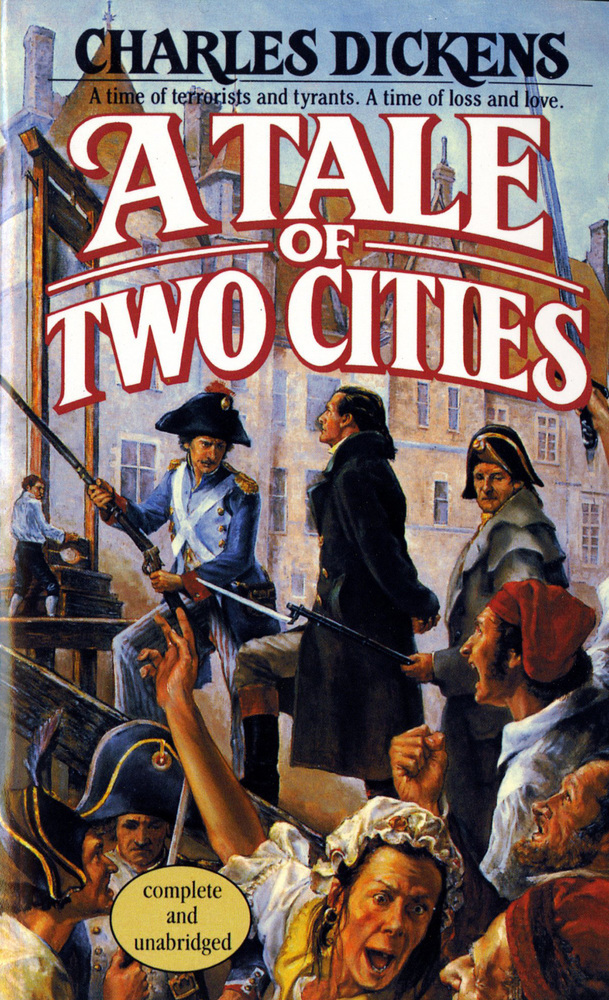
I can’t stop thinking of that interview Marie Forleo did with Brené Brown about her book Braving the Wilderness. When Brené was talking about the process by which we dehumanize other human beings, I thought of A Tale of Two Cities. There are many examples of how this process happens both in literature and in history, but the thing that Dickens does in his book is to make the process personal and devastating.

This story is so timeless that there are four film versions of it. My favorite is the 1938 version with Ronald Coleman, but every version I’ve seen is compelling.

The story takes place during the French Revolution. At the beginning of the story, Dr. Manette has been in prison for many years. He was imprisoned by aristocrats because he wouldn’t pledge to keep a secret they wanted buried. Since much of his work was with the poor of Paris, the De Farges, who had worked for Dr. Manette, try to get him released. In fact, that’s how the book begins, with Dr. Manette’s release. His wife and daughter had fled to England when he was taken, and now his grown daughter meets her father for the first time in many years. He’s a broken man.

Meanwhile, back in Paris, the De Farge’s are prominent members of the festering discontent that leads to the revolution. A single incident shows the callousness of the French aristocrats and sets the stage for the blood bath that is to follow. The Marquis St. Evrémonde, orders his coachman to speed through the poor part of the city. A child is crushed under the wheels of his carriage and he doesn’t care. Meanwhile St. Evrémonde’s nephew is packing to leave his title and his uncle behind. He can’t stand to see the way the people in his class are so callous toward the poor. And that’s the crux of the story. First the aristocrats devalue the lives of the poor, then the poor, having gained power, do the same to the aristocrats and those who work for them. Many innocent people end up dying at the guillotine.

The thing that has stuck with me since I first read the book when I was in high school was how quickly noble causes can be changed to bloody rampages. The De Farge’s have a just cause, but as they gain power they are seduced by blood lust. Their desire to right the wrongs their class has suffered turns against Dr. Manette and his family. Lucy Manette has married Charles Darnay, St. Evrémond’s nephew and the De Farge’s want to kill every last member of the family as if that would bring back the child who got trampled so many years before. It’s shocking how blind the De Farge’s and their cohorts become to the suffering they are causing.

My father used to say that wounded people, wound other people thinking it will ease their own pain. Pain, of course, is never eased by harming someone else. The only way to ease our pain is to forgive ourselves and others.

Sometimes life throws curve balls at us. Directing this play has been one of those situations for me. I have at times been sucked into the drama of situations with students, but getting upset and angry doesn’t help anything. I’ve had to take a step back and look at why I’ve drawn this into my life. The answer is, I have more guck to clear out so that I can be free of anger and blame.

It seems to me that stories like A Tale of Two Cities are examples of how tragic things can become if we fail to heal our own wounds. Trying to control things on the outside never makes us feel better. All the work must be done on the inside, in our own minds and hearts.

Thanks for reading, liking and commenting. I hope the rest of your week is lovely.

Lucinda Sage-Midgorden © 2018

Lucinda is the author of The Space Between Time, an award finalist in the “Fiction: Fantasy” category of the 2017 Best Book Awards. It’s a historical, time-travel, magical realism, women’s novel, and is available in all ebook formats at Smashwords, or you can find the ebook at iBooks or Barnes and Noble. I you prefer a physical copy, you can find a print-on-demand version at Amazon. To join her email list, click here. She will never sell the names on her list.

My Wilderness

“People are hard to hate close up. Move in. Speak truth to bullshit. Be civil. Hold hands. With strangers. Strong back. Soft front. Wild heart.” ~ Brené Brown, Braving the Wilderness

“The paradox is one of our most valuable spiritual possessions … only the paradox comes anywhere near to comprehending the fullness of life.” ~ Carl Jung

I’m directing a play this semester in addition to teaching two other classes. It’s my first time directing a Shakespeare play, which was a scary prospect, but the message in Measure for Measure called to me and I couldn’t stop thinking about doing it. I told Divine Oneness that if things fell into place, I’d go forward with the project. There have been many hurdles to jump over which I will not bore you with here. Let’s just say everything seemed to be falling into place. Students were excited about the play, as were other college instructors. I met a professional actor who had done the play seven times and gave me a shortened script, and there were so many other positive signs that I decided to move forward with the production.

We’re a week from our first performance and during the last few rehearsals everything has begun to fall apart. Last night I was so discouraged I cried all the way home and cried while telling Barry about all the obstacles that have been cropping up, ranging from college events that have kicked us out of our performance space two nights during our last week of rehearsals, to students who have to work when we’re supposed to be polishing the play. I was so distraught that I didn’t sleep well.

This morning I’m still feeling discouraged, which is not like me at all. But, yesterday I watched an episode of MarieTV that popped up on my YouTube feed when I opened it to access my meditation video. Marie Forleo is one of my favorite young women leaders. She supports women entrepreneurs. The video was from a few months ago when she was interviewing Brené Brown about her new book Braving the Wilderness: The Quest for True Belonging and the Courage to Stand Alone. Brené Brown is another one of my favorite women authors and teachers. I’ve read almost all of her books and had recently finished Wilderness. She studies the effects of shame and how vulnerability can help us live an authentic life. Marie brought up something that also touched me when I read the book.

Brené writes that if we are going to be authentic, we have to be careful how we talk to and about other people. If we are going to respond to people calling us, or the people we support, names by engaging in name calling in return, then we are perpetuating negativity. We’re contributing to the dehumanization process. We are making our fellow human beings, something not worthy of respect. If we want a loving, peaceful world, we need to stop demonizing the people who have different political, religious, or moral views than we do. Often our first reaction to being attacked is to attack back, to give evil for evil. Doing that is not going to make the world a better place in which to live. Maybe, giving love, for evil is what Jesus meant when he said to turn the other cheek.

So what does this have to do with what’s happening in my life right now. Well, I certainly would like to, (and I have) yell and curse, when the latest bombshell goes off exploding my plans for the play. I haven’t done it in front of the students until last night’s rehearsal. One of my students said, “I can’t believe you haven’t done that before now.” I realized that I have been stuffing my feelings and trying to protect my students. That’s not good for me or them. So, I’ve decided that I’m going to tell them that I cried all the way home because I failed to convey to them how important it is to be there for each other. That each member of our production is important and that we owe ourselves and the audience the very best performance we can give.

And one other thing occurred to me. I’ve been living a kind of double life these last nine years. I’ve been trying to balance teaching, which includes directing, with my writing life. I’m taking this experience as a sign that maybe I should give up teaching theatre all together and concentrate on writing. I have very much regretted that I have had so little time to work on my novel this semester. I need to go spend some time with myself and Divine Oneness in the wilderness and see what my next steps should be.

Thanks for reading, liking and commenting. I appreciate it very much.

Lucinda Sage-Midgorden © 2018

Lucinda is the author of The Space Between Time, an award finalist in the “Fiction: Fantasy” category of the 2017 Best Book Awards. It’s a historical, time-travel, magical realism, women’s novel, and is available in all ebook formats at Smashwords, or you can find the ebook at iBooks or Barnes and Noble. I you prefer a physical copy, you can find a print-on-demand version at Amazon. To join her email list, click here. She will never sell the names on her list.