Blessings of the Generation Gap

Lucinda’s Birthday with Arielle

“We are what they grow beyond.” ~ Yoda in Star Wars: The Last Jedi

“The young man pities his elder, fearing the day he, too, will join their ranks. The elderly man pities the younger generation, well-knowing the trials and tribulations that lie ahead of them.” ~ Lydia I Fisher

“America isn’t breaking apart at the seams. The American dream isn’t dying. Our new racial and ethnic complexion hasn’t triggered massive outbreaks of intolerance. Our generations aren’t at each other’s throats. They’re living more interdependently than at any time in recent memory, because that turns out to be a good coping strategy in hard times. Our nation faces huge challenges, no doubt. So do the rest of the world’s aging economic powers. If you had to pick a nation with the right stuff to ride out the coming demographic storm, you’d be crazy not to choose America, warts and all.” ~ Pew Research Center, The Next America: Boomers, Millennials, and the Looming Generational Showdown.

At the beginning of each new semester, I think anew about my students and what I will learn from them. Maybe it’s because I’m dedicated to life long learning that made me choose teaching as part of my career. My life is so much richer for the exchange of ideas that challenge my old ways of thinking and being and I’m grateful to meet new students each semester.

There are times when I feel angry and distressed when older people shake their heads and condemn the younger generations, or when the younger generations dismisses the contributions of those who came before them. The human race would never evolve if we had to begin all over again when a new generation emerges into the dominant positions as creators, leaders, inventors, and innovators. One generation must learn from the last and build on what they have contributed so that improvements can be made.

As I was preparing for my busy semester, I got to see Star Wars: The Last Jedi, for a second time. The first time I saw it, one quote stuck with me. It’s the one above by Yoda, “We are what they grow beyond.” I loved that statement. However, the second time through, I heard the second part of that quote, “and that is the pain (or maybe it was sorrow) we bear.” And I thought, “Wait what?” I don’t bear any burden if my students take something they’ve learned from me and use it to grow beyond my understanding or talents. That’s the joy and reward of teaching.

I’m not saying anything new when I state that we are in a time of great change and we have to rely upon one another even more than before, so when I found the above quote by the Pew Research Center, I rejoiced. I don’t want to tell my students or any of the younger generations that I’m smarter than they are. I want to learn from them and work with them to create a much more equitable, sustainable world in which to live. And I want to appreciate the many contributions of the generations that have gone before as well. Change is always disruptive, but in my mind, that’s a good thing. I’d get bored if my life was the same day after day with no hope for something new and exciting to look forward to. When the forces of change arrive, we get a chance to keep what works and throw out what no longer serves us. It’s a long process sometimes, but well worth the work.

I’m off to auditions for the play I’m directing, Measure for Measure and excited to hear what my students have to teach me about this play written so many centuries ago. It’s amazing that the works of Shakespeare contain so many ideas that apply to events today and give us clues about how to face our challenges.

Have a lovely weekend.

Thanks for reading, liking and commenting on my posts. I appreciate reading your take on what I’ve written.

Lucinda Sage-Midgorden © 2018

Lucinda is the author of The Space Between Time, an award finalist in the “Fiction: Fantasy” category of the 2017 Best Book Awards. It’s a historical, time-travel, magical realism, women’s novel, and is available in all ebook formats at Smashwords, and print-on-demand at Amazon and other fine book sellers. To join her email list, click here. She will never sell the names on her list.

My Words for the Year

January 9, 2018 Sunrise

“What lies behind you and what lies in front of you, pales in comparison to what lies inside you.” ~ Ralph Waldo Emerson

“I want all the girls watching here today to know that a new day is on the horizon.” ~ Oprah Winfrey

“… other than a few useful details, the past is mostly a prison. It prevents me from seeing and experiencing life as it is now.” ~ Pam Grout

I came to a shocking awareness this morning. I’ve been afraid most of my life. I don’t think I’m alone in this given many of the posts I read on social media. You probably already know the details of how fear has reared it’s ugly head for me, because that insipid monster in your head tries to undermine you too. Fortunately, three events came together to help me see myself and my life in a new way.

First, as I often do in the winter, I opened the blinds to look at the sunrise. It was particularly beautiful this morning with the clouds over the San Jose Mountains turning shades of pink, peach and orange.

Second, Barry and I watched Oprah’s amazing speech at The Golden Globes, and wept together. The tide is turning and the more people who speak up about what has happened to them, the harder it is for the perpetrators to make excuses for their actions.

Third, after he left for work, I went to do my daily meditation and my A Course In Miracles lesson. The lesson was this: “My mind is preoccupied with past thoughts.” During my meditation I saw myself standing on a hilltop with the sun rising on a fresh new day. I felt for the first time, that even though I’ve been afraid for so long, I can let it go forever. That other little voice in my head that’s been telling me I’m loved, worthy, and talented, can now be the guiding force in my life with no competition.

A couple of Sundays ago, Faith Salie had a wonderful segment on CBS Sunday Morning about how art has helped her see her life in a new way. There are two words used in the art world that she said she wants to be her words for this new year. The first is, pentimento, the presence or emergence of earlier images, forms, or strokes that have been changed and painted over. She used the example of some Henri Matisse drawings she’d seen, which show places he erased so that he could improve the drawing. To her this meant he repented and changed his mind about what he was creating. That’s something we can all do with our lives. We can take a step back, change our minds about where we’re going and construct something new out of the broken pieces. Which brings me to the other word she is embracing, kintsugi, the Japanese practice of repairing broken ceramics with gold.

Each of us is broken in some way. Some of us stay broken and that becomes our story. But others of us accept our flaws and brokenness and in doing so we become stronger; we’re able to help others stitch together their broken places as well. We can take the lessons we’ve learned along the way and let them propel us, with no regrets, into the sunlight of a new day.

So, I’m joining Faith Salie, and adopting pentimento and kintsugi as my words for the year. Today is a fresh, new beginning. And for the first time in a long time, I feel like my life is new and full of all kinds of previously unimagined possibilities.

Thanks for reading, liking and commenting. I hope you have a fabulous new year.

Lucinda Sage-Midgorden © 2018

Lucinda is the author of The Space Between Time, an award finalist in the “Fiction:Fantasy” category of the 2017 Best Book Awards. It’s a historical, time-travel, magical realism, women’s novel, and is available in all ebook formats at Smashwords, and print-on-demand at Amazon and other fine book sellers. To join her email list, click here. She will never sell the names on her list.

Rigid or Pliant

The Duke and Isabel in Measure for Measure.

“We must let go of the life we have planned, so as to accept the one that is waiting for us.” ~ Joseph Campbell

“No matter what people tell you, words and ideas can change the world.” ~ Robin Williams

“They say best men moulded out of faults;
And, for the most, become much more the better
For being a little bad; so may my husband.” Mariana in Measure for Measure by William Shakespeare

I’m preparing to direct a lesser known Shakespeare play, Measure for Measure this spring. If you don’t know it, it might be worth your while to read, listen to, or watch it. Here is a brief synopsis of the play:

The Duke of Vienna is facing a dilemma. Licentiousness is overtaking the the city. The laws are harsh against this behavior, especially sexual misconduct. The Duke has not enforced these laws for nine years, presumably because he doesn’t agree with them, or perhaps he has just inherited his title and is unsure of how to proceed.

He goes out into the city disguised as a friar to observe and listen to the regular people. In his place he leaves Angelo, one of his deputies – who is thought to be a pious and upright man – in charge with the Duke’s full powers. He asks Escalus, another deputy, to be Angelo’s second in command.

The minute the Duke is gone, Angelo begins to show his true colors and abuses his power. He makes an example of Claudio and his betrothed, Juliet, by arresting them because they are about to become parents. Angelo condemns Claudio to death within a few days time.

Isabella, Claudio’s sister goes to Angelo to plead for her brother’s life. Angelo is taken with her and tells her he will release her brother if she will “love” him.

The Duke hears of this and sets about exposing Angelo and saving Isabella, Claudio, and Juliet.

In a conversation with our guest artist, who has done this play seven times in one capacity or another, he pointed out that both Angelo and Isabella are rigid, inflexible people. That was an idea I had not considered as I was studying the play once again. That idea got me wondering why that might be. What is it about these two people that make them want to keep such a tight reign on their emotions? At first I didn’t understand them, until I remembered that when I was a teenager, I had very much the same attitude.

Perhaps it was because my mother kept telling me that I needed to control my emotions, or it might have been because of the fact that we moved a lot as I was growing up. I attended two different elementary, junior high, and high schools. Over the years I became very guarded in my interactions with the other students. I wanted to retain as much control over myself and my environment as possible because who knew when we were going to pick up, move again, and I’d have to start all over with a new school environment and set of friends.

Slowly, as I graduated high school and sought out new experiences, I began to open up and become more flexible. But as I did, an interesting thing happened. I was confronted over and over again by inflexible people who wanted to control my life decisions. I learned something very valuable from those controlling people. Trying to make life fit into the little box of one’s belief systems is a death sentence for the soul. We are confronted with all kinds of life experiences and often what we had planned for our lives gets shattered in some way and we have to regroup.

People who are flexible, open their eyes to all the myriad possibilities that might be better than what they originally planned for themselves. They learn to accept their flaws, mistakes and wrong assumptions, and use them to become better people.

Inflexible people have it much harder. They become judgmental, or depressed, or angry, or live lives of quiet desperation because they don’t want to do any self-examination.

In Measure for Measure, it’s unclear whether Angelo and Isabella embrace the chance at self-examination and growth. The play ends before we know their decisions. But Mariana’s line that I quoted above (she’s Angelo’s rejected betrothed) is, to me, the main theme of the play. The fact that she gets Isabella to forgive Angelo, and the Duke to rescind his order to have Angelo executed, is an indication that her loving and open nature will have a profound effect on all three of the main characters in the future.

That line has already had a profound effect on me. It has made me want to release more of my rigid thought patterns and become even more open and pliable so I can be of better service to those around me.

In closing I want to share one of my favorite quotes from the Tao Te Ching. When I first read it, the truth of the words resonated deep within and cemented my resolve to become a flexible person. This has been a lifelong process.

Tao Te Ching 41 (76) New translation by Victor H. Mair

“Human beings are
soft and supple when alive,
stiff and straight when dead.

The myriad creatures, the grasses and trees are
soft and fragile when alive,
dry and withered when dead.

Therefore, it is said:
The rigid person is a disciple of death;
The soft, supple, and delicate are lovers of life.

An army that is inflexible will not conquer;
A tree that is inflexible will snap.

The unyielding and mighty shall be brought low;
The soft, supple, and delicate will be set above.”

These are just some things I’ve been thinking about as I’ve studied this most interesting play.

Thanks for reading, liking and commenting. I appreciate your thoughts.

Lucinda Sage-Midgorden © 2018

Lucinda is the author of The Space Between Time, an award finalist in the “Fiction: Fantasy” category of the 2017 Best Book Awards. It’s a historical, time-travel, magical realism, women’s novel, and is available in all ebook formats at Smashwords, and print-on-demand at Amazon and other fine book sellers. To join her email list, click here. She will never sell the names on her list.
It’s All in Our Heads

Human Brain Thinking

“Perception is reality.” ~ Lee Atwater

“The best and most beautiful things in the world cannot be seen or even touched – they must be felt with the heart.” ~ Helen Keller

“It ain’t what you don’t know that gets you into trouble. It’s what you know for sure that just ain’t so.” ~ Mark Twain

This has happened to me and maybe it has to you too. You’re going along, life is great, or not so great, but familiar and … boom … something happens and your life is turned upside down. It can be something as small as a minor car accident that disrupts your life for a while, to something big, like losing your job, your spouse, or receiving a life threatening diagnosis. The way we react or respond to these types of events is literally all in our heads.

I used both words react and respond in the above sentence because to me they are two different ways of conducting oneself in everyday life. To react, in my mind, is negative. Someone says or does something and instead of taking in the information and evaluating it, we go on the attack. To respond is to take a few breaths, look at all sides of what has happened, and then decide how we are going to proceed in that situation.

Over the years I’ve changed from someone who reacts to events and people, to someone who responds. I don’t remember the exact incident, but I do remember the feeling of relief when I accepted that I was responsible for my life. And that my nature was made up of both light and darkness. It wasn’t always easy to make the change from feeling like the world was against me to realizing that it was my attitude that had an affect on the way I was experiencing life. But little by little I stopped looking outside myself for solutions and began untangling all the junk assumptions I’d held onto for so long.

I was reminded of how I transformed my life when I read a very introspective blog post by Sam Wood titled “The Last Jedi, toxic masculinity, and showing your place in all this”

I’m a big Star Wars fan, have been since the first movie came out in 1977. It’s an epic series about light and dark, facing personal demons, and finding your path. And after watching The Power of Myth a conversation between Bill Moyers and Joseph Campbell, who happened to be George Lucas’ teacher, I realized that we create myths to explain our deepest fears, hopes, and dreams. Most of the science fiction, fantasy, and superhero books and movies produced today are our modern myths. They help us figure out real life issues from a safe distance.

The thing I loved about Sam Wood’s post was his examination of a car crash kind of turning point in our world, that of white male identity. Here’s a telling quote from the article: “It’s no mistake I say ‘he’. Heroism, protagonessence, being the best, being supreme is the legacy of whiteness, of patriarchy, of heteronormativity. It is the toxicity that suffuses the identity of young white men, that suffuses my identity. And before The Last Jedi I had never seen it been represented simultaneously so sympathetically, and with so little indulgence of my bullshit.”

When I read this blog post, I had seen The Last Jedi twice, and I thought his observations were brilliant. The “heroes” of the story all have a very male point of view. They think of themselves as heroes and it’s their job to save the day, or berate themselves for failing to do so. Okay Finn doesn’t accept that mantle, but people keep trying to thrust it upon him. Each man struggles with this way of seeing themselves. And what happens? Each of them fail epically. When that happens, the way they see themselves and the world is shaken, which gives them the opportunity to change their perceptions.

It’s the women, Rey, Leia Organa, Vice Admiral Holdo, and Rose, who propose new ways of looking the world and themselves. When Rose stops Finn from a Kamikaze stunt, he asks her why. She says, “We’re going to win this war not by fighting what we hate, but by saving what we love!”

Rey resists Kylo’s plea to join him in ruling the galaxy. She tries to get him to acknowledge his own light, but he refuses. She follows her own inner guidance and rejoins the resistance.

And in the end, when there are only about forty resistance fighters left, Rey asks Leia how they can turn the tide against the evil First Order. Leia says, “We have everything we need.” In other words, it’s what they have inside that counts, not the number of weapons they wield.

The story belongs to Rey and the other women. They offer Luke, Po, Finn, and Kylo the opportunity to change. They invite them to be a part of a bigger and more important effort to change the galaxy through cooperation. Kylo is the only one who doesn’t accept. He wants to ease his suffering by becoming supreme leader thinking that will solve all his problems. He doesn’t understand that his problems are imaginary, created inside his own head and emotions. That’s how it is with all of us, we create our own problems. And that’s where we have to solve them.

There are times when I look at the way my life is going and I’m tempted to slide back into blaming the fates for the things I’d like to be different. 2017 was that kind of year. But then I remember, that the world I see is the one I’ve created and I can change my mind any time I so choose. Since blaming events outside myself hasn’t made anything in my life better, I think I’ll take a step back and let go of some more of the things I thought I knew for sure.

Blessings for your new year. Thanks for reading, liking and commenting. I appreciate it.

Lucinda Sage-Midgorden © 2018

Lucinda is the author of The Space Between Time, an award finalist in the “Fiction: Fantasy” category of the 2017 Best Book Awards. It’s a historical, time-travel, magical realism, women’s novel, and is available in all ebook formats at Smashwords, and print-on-demand at Amazon and other fine book sellers. To join her email list, click here. She will never sell the names on her list.

Things I Learned in 2017

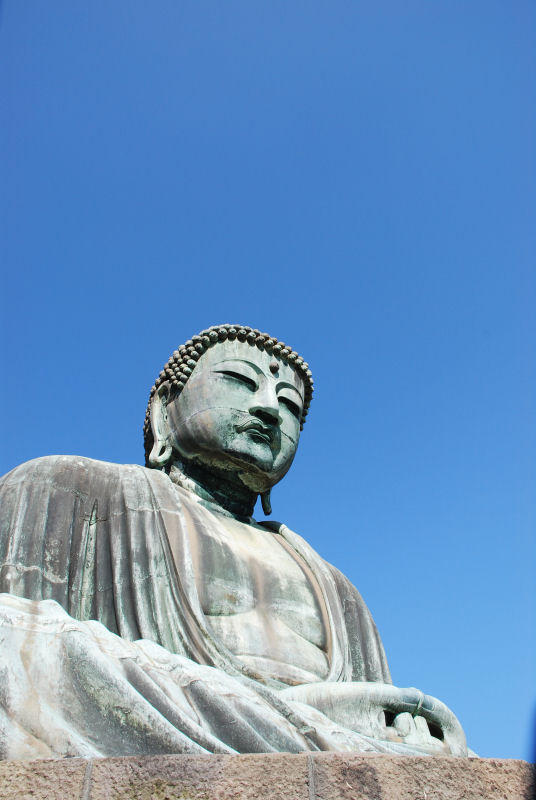
Great Buddha, Kamakura, Japan

“The highest virtue does nothing. Yet, nothing needs to be done. The lowest virtue does everything. Yet, much remains to be done.” ~ Tao Te Ching chapter 38

“Start by doing what’s necessary; then do what’s possible; and suddenly you are doing the impossible.” ~ Francis of Assisi

“Happiness does not come from doing easy work but from the afterglow of satisfaction that comes after the achievement of a difficult task that demanded our best.” ~ Theodore Isaac Rubin

“We ourselves feel that what we are doing is just a drop in the ocean. But the ocean would be less because of that missing drop.” ~ Mother Teresa

I’m not big on publishing lists. I know they’re the “thing” now. “Follow this list and/or do these 12 things to get …” Or, “These 14 books are must reads.” If you’re on social media, they float by your feed and are oh so tempting to read. Of course, for most of us, this year has been an extremely trying one with the state of politics in this country. And social media is a place where facts and opinions fly around as if they’re in a tornado. That’s why I’ve cut back on my social media time, and ignoring those lists, news reports, and opinion polls to pay more attention to my real friends has made me much happier.

Since, I’m happier and always thinking about what my experiences can teach me, I wanted to break my own rule and share some things I’ve learned this year. I’m not publishing them in a list, and you can take them or leave them as you choose. I do not profess to know what’s best for anyone. I’m still trying to figure out my own life.

I’m a slow learner. Some of the seeds for what I learned this year actually began in 2015. That’s the year I read and studied A Course in Miracles. I know, that’s the kind of book you can study your entire life and still gain new insights. So, I’m thinking of picking it up again on January 1 and studying it in 2018.

In any case one lesson I learned from my 2015 study was the whole idea of non-action. I didn’t understand that concept fully until this year, or at least, I understand it on a deeper level now. I may never fully understand it. Non-action is a concept I first encountered when I studied the Tao Te Ching years ago. It’s this paradoxical situation where, if you adopt non-action, you can accomplish more than if you run around filling every day with tasks to be accomplished. The way I understand it now is that if you have something you need to do, you wait for guidance before you act, you usually get a better solution than the one your tiny little ego would come up with.

I’m not good at this practice you understand, but when the presidential election blew up and some new attack on human rights, and the environment ensued on a daily basis, I felt paralyzed. What could I, one person, do to fight the descent into darkness? But I remembered lessons from all the spiritual teachers I’ve read over the years, and I felt really uncomfortable with that word “fight”. My understanding of non-action is still imperfect, but my experience has shown me that the statement “What you resist, persists,” is true. Practicing non-action gives you a chance to come up with a new solution to any problem. For example, I worked at a job I hated. All I could think about was how much I hated that job. And it got worse, not better until finally I nearly had a nervous breakdown and realized, I had the power to change my life if I allowed myself to get a new perspective. That was a huge turning point in the way I approached problems. But, I was still stuck in many old ways of thinking.

During graduate school, I took some playwrighting classes. I loved everything about writing, but I couldn’t see how I could make a living as a writer, so I set that aside. Money and creativity didn’t go together in my mind. Eventually, however, my desire to write became so strong that I quit my teaching job to become a full-time writer. And little by little, my thinking that money and creativity are mutually exclusive has been changing. I’m learning that writing to make money is not the goal. It most likely will not bring cash to my bank account. Expressing my viewpoint about life and working to understand myself better is now my goal. And if I can touch someone else with what I’m learning, then that might bring me some income, but more importantly, I will be adding to my own, and other people’s awakening.

I learned another vital lesson as I published my first novel this year. When working on a big project, you have to do the work in little chunks. There are definite stages to writing a book. Working on the first draft can be nerve wracking, especially if you’re someone like me who doesn’t do outlines. I get the general idea for my story and characters, but even if I plan to take the story in a certain direction, some other idea will take precedence. My characters don’t talk to me, but the muses visit me at odd times and I’m often surprised at what they tell me I need to write.

Once that first draft is finished, and that might be years after I started it, the fun part begins. At least I think it’s the fun part. Revising, reorganizing, filling in the blanks, and cutting out the unnecessary parts. After that the tedious process of line editing needs to be done. I’m not so fond of that part. But it’s better to make the manuscript as pristine as possible, because you never get another chance to make a good first impression.

And finally, when I published The Space Between Time, after seven years of work. I felt happy and satisfied. Like I had contributed something new to the world. It’s an intoxicating feeling similar to the way I feel at the end of a long rehearsal process when the play is appreciated by the audience. And no amount of money or awards can match that feeling of knowing I’ve done a job well.

I’m still working on the whole creativity, money connection, and letting go of my old viewpoint about money and it’s importance in our lives. I do know that following my creative urges has always brought rewarding experiences, and interesting people into my life. So, for now, I’m going to forget about the money part, and just keep working on developing my creativity muscles. Maybe if I do that, I’ll get to meet some really interesting people and even do some traveling to book signings and talks about my creative process. That would be really fun!

I hope 2018 proves to be a good, and enlightening year for you.

Blessings, and thanks for reading. I appreciate your likes and comments.

Lucinda Sage-Midgorden © 2017

Lucinda is the author of The Space Between Time, an award finalist in the “Fiction: Fantasy” category of the 2017 Best Book Awards. It’s a historical, time-travel, magical realism, women’s novel, and is available in all ebook formats at Smashwords, and print-on-demand at Amazon and other fine book sellers. To join her email list, click here. She will never sell the names on her list.